The engineering recruitment companies you find online aren’t interchangeable. They differ by which engineers they already know.
Consider a managed service provider (MSP) hiring a client-facing network engineer, and an architecture firm hiring a structural engineer. Both searches run in separate labor markets, and the same recruiting company may answer both calls. Sorting the field takes two steps, so check the discipline first, then define the seat so the submissions match the job you run.
Engineering Is Six Labor Markets
Search for an engineering recruiter and you’ll find five sites that look the same. Two weeks later you’re reviewing near-matches that still miss the role.
One word covers professions that share no candidate network. The network that produces controls engineers for manufacturers barely overlaps the one that produces structural engineers for design consultancies. Neither resembles the world of platform engineers. Most companies put engineering on the website because buyers search for it, and that tells you nothing about who they can reach by Thursday.
So the first question isn’t their process. A firm earns the word engineering one discipline at a time. Ask for recent placements in the kind of employer you hire from, and for a recruiter who can talk shop without reading your job description back to you. The six families below rarely share candidates, and almost never share recruiters.
| Discipline family | Example seats | Where those engineers work | What proves a company covers it |
|---|---|---|---|
| Structural and civil | Structural engineer, bridge engineer, project engineer | Design consultancies, civil contractors, public agencies | Placements in the same sub-discipline, and a recruiter who knows which codes and deliverables the seat owns |
| Mechanical and manufacturing | Design engineer, manufacturing engineer, new product engineer | OEMs, contract manufacturers, product companies | Placements tied to similar products and plant environments, with outreach aimed at engineers who already have jobs |
| Electrical and controls | Controls engineer, PLC engineer, electrical design engineer | Manufacturers, systems integrators, utilities | A recruiter who can name the controls stack and tell panel design apart from commissioning work |
| Software and platform | Backend engineer, DevOps engineer, site reliability engineer | Software companies, product teams, internal engineering groups | Placements sorted by stack and by level, and a clear read on where an individual contributor ends and a lead begins |
| Network and systems | Network engineer, systems engineer, cloud administrator | MSPs, IT service providers, internal IT teams | Placements in service-delivery shops, where on-call load and client-facing work decide the fit |
| Process and chemical | Process engineer, project engineer, plant engineer | Refineries, chemical plants, engineering and construction firms | Placements in regulated plant environments, and candid talk about shift patterns and safety culture |
A company that can’t name which of those families it places in every month is forwarding resumes with an engineering label on them.
A few disciplines also need a licensed signature on the drawings, which narrows the pool again before anyone sources. Our page on engineering executive search covers how that works at the leadership level.
Ask for Three Placements in Your Discipline
The fastest filter is proof in your own lane. A slide of client logos and a page headed Engineering Recruiting aren’t evidence, and a company that hasn’t placed your discipline lately is guessing at your expense.
Ask one question on the first call, then hold out for specifics. Walk me through three recent placements in my discipline, with the title, the kind of employer, and what the search looked like. A real discipline partner answers without stalling or swapping in an adjacent role.
Four details make the answer measurable:
- Seat match: The same discipline at the same level. A close cousin doesn’t count.
- Employer context: The kind of shop you hire from, anywhere from an MSP service desk to a plant floor.
- Sourcing reality: Direct outreach to engineers who already have jobs, and a straight answer about how much of the pipeline arrives inbound.
- Reason for movement: The on-call rotation, the travel load, the project backlog. Growth is what a candidate says when nobody asked a second question.
For an MSP hiring a client-facing network engineer, “we placed a systems engineer at a healthcare company” tells you nothing. A useful answer sounds like this. Placed into a service-delivery shop, calibrated the on-call rotation and the escalation expectations, and ran outreach to engineers already working tickets.
The rest of the vetting list is on our engineering recruiter guide, which keeps the first call from turning into a two-hour interview.
Define the Seat Before You Define the Title
Most bad submissions start on your side of the table. A title and a keyword list leave the company to guess what the job produces and who it serves, and a guess at that stage costs a month.
Take a mechanical engineer. One version bills hours to a client. A second signs off on drawings inside a permit set. A third owns an internal product line where the customer works down the hall. Three candidate pools answer to that one title, and they want different things from an offer.
The interviews separate too. For a billable seat you’ll test utilization, client communication and deadline math. For stamped work you’ll ask how someone reviews a drawing and documents a decision. For an internal seat you’ll dig into prioritization and cross-functional conflict. Same title, three screens.
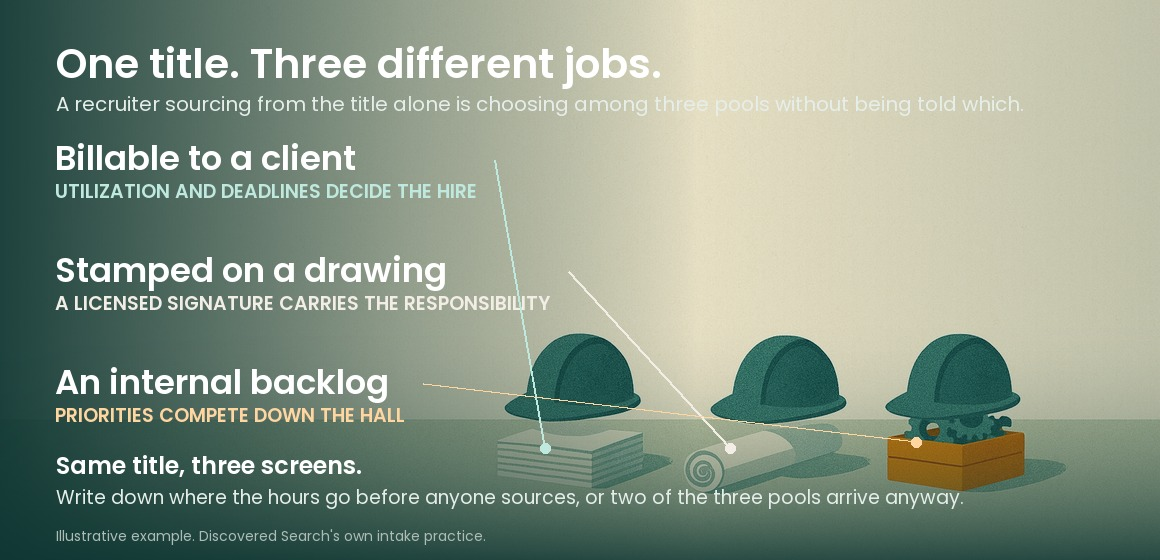
Write the seat definition down before anyone starts outreach. Three questions cover it. Where do this person’s hours go? Who is the customer? What output proves the hire worked inside 90 days? Answer those yourself first. A fuzzy answer is a scoping problem, and no amount of sourcing fixes it.
Backlog Hiring Shrinks the Window
Architecture and engineering firms don’t hire off an org chart. They hire because a project award turned into a mobilization date somebody already promised a client.
The calendar gets tight fast. A quality engineering hire typically takes 4 to 12 weeks, and a client’s schedule won’t wait for a search to warm up. Opening the search the week the award lands means opening it late.
Run outreach ahead of the award instead. Name the disciplines next quarter’s pipeline will likely need, keep those conversations warm, and the mobilization date arrives with three screened engineers already in process. A per-hire fee buys none of that work, because nobody has placed anyone yet. A monthly fee does. That’s the practical reason fractional recruiting, an outside recruiter running your hiring for a flat monthly fee, fits a backlog-driven shop.
When One Company Can’t Cover Your Hiring Plan
Sometimes no single company covers the year. A shop built on controls work won’t have a warm network of structural project managers, and a structural shop won’t have a bench of platform engineers. Ask for all three from one boutique and the answer you get is confidence, with no relationships behind it.
Two arrangements work. Run one specialist relationship per discipline and absorb the coordination yourself, which means separate status calls, separate scorecards and separate feedback loops. Or choose one process partner who runs a single intake, one scorecard and one submission cadence across every open role. Underneath that, the partner sources each discipline its own way.
Volume decides it. At two to five technical hires a year across mixed disciplines, coordinating three vendors usually costs more attention than the extra depth returns. For software seats, our software engineer recruiter page has the detail. For network and systems seats, the MSP page does.
Frequently asked questions
What Proves a Company Covers My Discipline?
Three recent placements in your discipline, each with a title, an employer type and a description of the search. A company that can’t describe the details that move candidates in your world, like on-call load, commissioning travel or a backlog-driven schedule, is selling you marketing.
How Many Companies Should I Talk To?
Enough to hear three placement stories in your discipline, which is usually two or three companies. Past that the calls stop producing new information and start producing duplicate submissions. One owner per open seat also keeps fee disputes off your desk.
What Does Direct Outreach Mean, and Why Does It Matter?
Direct outreach means the recruiter contacts engineers who already have jobs and aren’t applying anywhere. Inbound applicants add volume, and a pipeline made mostly of them skips the hardest part of the work. Our page on how we find candidates walks through the channels.
What If the Role Changes Halfway Through the Search?
Normal. A project shifts, a client changes scope, or the first seat definition misses. Ask what the engagement does about it before you sign. On a flat monthly fee a re-scope is part of the month, with unlimited sourcing and screening inside the engagement. On a per-hire fee a re-scoped search becomes a negotiation.
Do We Pay More for a Hard-to-Find Discipline?
On a percentage model, yes, because the fee follows the salary, usually 20 to 30 percent of the first year. A flat monthly fee doesn’t move with the title, so a niche controls seat and a help desk seat cost the same month. Discovered Search charges $1,500 a month on a six-month commitment, or $2,500 month to month, with a 30-day money-back guarantee.
If fractional looks right on paper and you want to test it against your own hiring plan, schedule a 30-minute call with Discovered and we’ll run the numbers with you.