
You lose a senior PM mid-project, but you can’t go to the client and ask to pause the job. Posting for a replacement doesn’t fix things. You start paying for schedule slip and overtime, and then you compete for the same supers and PMs every other GC is calling.
Fractional recruiting for construction companies replaces last-minute posting with an operating rhythm. That includes weekly pipeline review, scheduled outbound to working PMs and supers, and structured screening, all on a flat monthly cost rather than a per-placement fee. In this article, you’ll see what that model looks like in practice and where Indeed and ZipRecruiter break down. You’ll also see how to compare a 15% to 25% contingency fee to $1,500 to $2,500 a month when you’re making 3 to 10 hires a year.
The Coverage Gap Where Margin Dies
When you lose a PM, super, or foreman midstream, you create a coverage gap that spreads across the job. RFIs sit, subs stop getting answers, and you start buying time with overtime that isn’t in the bid recap.
Picture a GC with an $8M project where the super walks and the next qualified replacement isn’t hired for weeks. The immediate cost isn’t the recruiter invoice. A week of schedule slip can turn into expedited materials and weekend work. Waiting for the “right” applicant feels prudent, but on an active job it usually converts margin into delay, rework, and owner frustration.
Reactive posting is structurally slow in construction because your process starts at zero right when you need speed. Top supers and foremen rarely live on job boards, and active seekers often stack competing conversations within days. “Post and wait” makes your schedule dependent on inbound, even though the candidates you want are usually already employed. The signs show up across the job:
Open RFIs and submittals aging past your normal threshold
PM and super coordination meetings getting rescheduled
Weekends added to keep the schedule afloat
Change order documentation getting thinner or delayed
What Fractional Recruiting Looks Like In Construction
A fractional recruiting service takes over the heavy lift week to week, while you keep the hiring calls. The recruiter handles:
Outbound outreach to working supers and PMs
Screening calls
Tight follow-up to keep candidates warm
Interview scheduling
Weekly pipeline view for every open role
You’re in charge of the role definition, speed, and yes/no calls. For example, if you need a traveling super and a foreman bench, the recruiter builds two pipelines in parallel, keeps candidates warm while your PMs, supers, and project engineer are on sites, and surfaces who’s real versus who’s just shopping.
Your part is non-negotiable. Show up for a short weekly huddle and unblock compensation ranges fast.
A weekly hiring review is only useful if you measure the same recruiting inputs and outcomes consistently across roles. Read more in our article: 9 Essential Metrics To Track Hiring Success Retention Take longer than 48 hours to return feedback and the candidate goes to your competitor. Calling that “being thorough” doesn’t change the outcome.
The Channel Tradeoffs You Are Already Paying For
By the end of the week, you can have dozens of applicants and still no one you’d confidently staff on a job. Meanwhile, the candidate you wanted took a call from a recruiter and is already scheduling a second interview somewhere else.
| Channel | How it’s priced | What you get | What you pay for (in practice) | Best use |
|---|---|---|---|---|
| Job boards (Indeed, ZipRecruiter) | Low upfront posting cost | Inbound applicants | Noise, screening time, slow cycles when top candidates are already employed and move fast | Entry-level or when you have internal bandwidth to screen quickly |
| Word-of-mouth / crew referrals | No direct fee | Warm intros from your network | Slow, narrow reach; can mirror your current team and miss quiet performers at competitors | Supplementary source for trusted additions |
| Contingency construction recruiters | Per placement (often % of first-year comp) | Targeted candidates; can move fast | Incentive to close the placement, not maintain an always-on bench; can be expensive per hire | Urgent, hard-to-fill roles when you want speed per req |
| Fractional recruiting | Flat monthly | Weekly outbound, follow-up, scheduling, and a live pipeline across roles | Requires your cadence on role clarity, comp ranges, and fast feedback to convert pipeline into hires | Continuous pipeline for roles you backfill repeatedly (PMs, supers, estimators, foremen) |
You can reduce contingency fees when your team has a structured way to evaluate what separates true high performers from average applicants early in screening. Read more in our article: How To Identify What Distinguishes High Performer Candidates.
The economics: flat monthly vs per placement
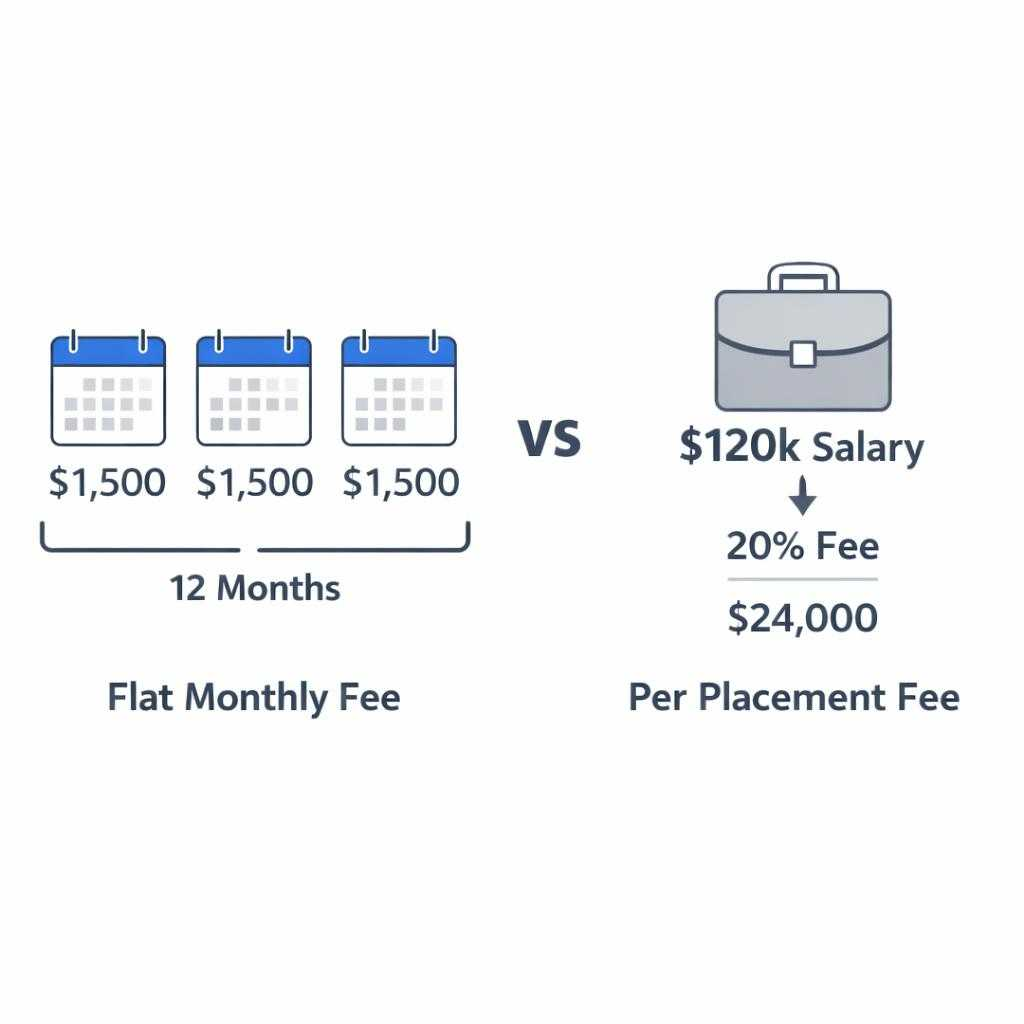
A 15% to 25% contingency fee looks like a line item until you run it against how often construction teams actually have to replace people. BLS JOLTS data shows nonfarm monthly quits hovering near 2% through late 2025. That’s not a one-off cost but a predictable annual drag.
If you’re making 3–10 hires a year, contingency fees behave like a tax you only notice when it spikes. Most agencies still price per placement as a percent of first-year comp (often 15%–25%), so a single $120,000 PM hire can easily cost $18,000–$30,000 in fees, before you count your PMs, supers, and project engineer’s time coordinating interviews and chasing references.
On a flat monthly model, you’re usually in the $1,500 to $2,500/month range, so your rough break-even is simple: one contingency placement can equal 7–20 months of fractional spend, depending on comp and fee percent. If quits keep forcing backfills, hiring becomes recurring, and contingency pricing just makes the spend harder to forecast.
Flat monthly recruiting is often easiest to compare when you treat it as a subscription delivery model with defined scope, cadence, and accountability. Read more in our article: Recruiting As A Service
FAQ
How Much Does Fractional Recruiting Cost For A Construction Company?
Most construction firms land in the $1,500 to $2,500/month range on a flat monthly model, with scope tied to how many roles you’re running at once and how much outbound you need. The point is predictable spend across multiple hires instead of a $10K to $25K spike every time you replace a PM or super.
Can Fractional Handle Field Hires (Foremen, Journeymen) Or Just Office Roles?
You can run both, as long as you treat it like pipeline, not posting. A good fractional motion sources working foremen and journeymen through outbound and fast screening, while keeping separate lanes for office roles like PMs and estimators.
How Fast Can We Get A PM Hired With Fractional?
You move as fast as your decision cadence and comp clarity allow, because PM candidates typically take multiple calls and compare offers. If you can keep interviews tight and feedback inside 24 to 48 hours, fractional is usually as good or better than contingency timing because you’re not starting from zero.
What About Union vs Non-Union? Does Fractional Handle Both?
Yes, but the playbook changes: union field staffing has to respect hall rules and referral processes, while non-union leans harder on outbound and network mapping. The key is agreeing up front on what the recruiter owns (pipeline and screening) versus what your PMs and supers own (site-specific requirements and final selection).
Related reading: Fractional Recruiting for MSPs · How to Choose a Fractional Recruiting Partner
If you’re losing PMs and supers to competitors and the next project starts in 8 weeks, schedule a 30-minute call with Discovered. We’ve placed 100+ construction roles and we’ll show you what continuous-pipeline hiring would look like for your firm.