An IT staffing agency fills one seat and charges you for that seat. The bill arrives in one of three shapes. Contract staffing, contract to hire, or a placement fee on the close.
For a 10 to 100 person MSP, the pricing model matters more than the pitch. A contingency placement fee typically runs 20 to 30 percent of first-year salary, so a $120,000 network engineer costs $24,000 to $36,000 on hire day. Contract staffing keeps its price in the spread between the hourly bill rate and the tech’s hourly wage, and that spread keeps earning after your crisis ends.
What You’re Buying from an IT Staffing Agency
Call an agency about a help desk opening and you get a quote. That quote reflects one of three commercial arrangements, usually the one that protects the agency’s economics rather than the one that fits your hiring plan.
Contract staffing puts the tech on the agency’s W-2 and in your ticket queue, billed by the hour. Coverage starts fast. The agency stays the employer of record, so what you bought is staff augmentation with a margin inside the hourly rate.
Contract to hire is that same arrangement with a conversion fee or a waiting period attached. You’re buying a tryout plus a defined path onto your own payroll.
Direct placement is a fee on the close, and it’s what most MSP owners think they’re asking for. Agency conversations often steer back toward contract terms anyway, because that is where the revenue continues if the role drags or you pause hiring.
None of that is dishonest. Each model prices a different thing. The trouble starts when an owner compares an hourly bill rate to a placement fee and reads them as the same purchase.
What IT Staffing Agencies Cost, Model by Model
Price the model against your next twelve months rather than your last hire. One hire and done makes a per-hire fee clean and rational. Two or three hires in a year turns it into a repeat purchase of the same function.
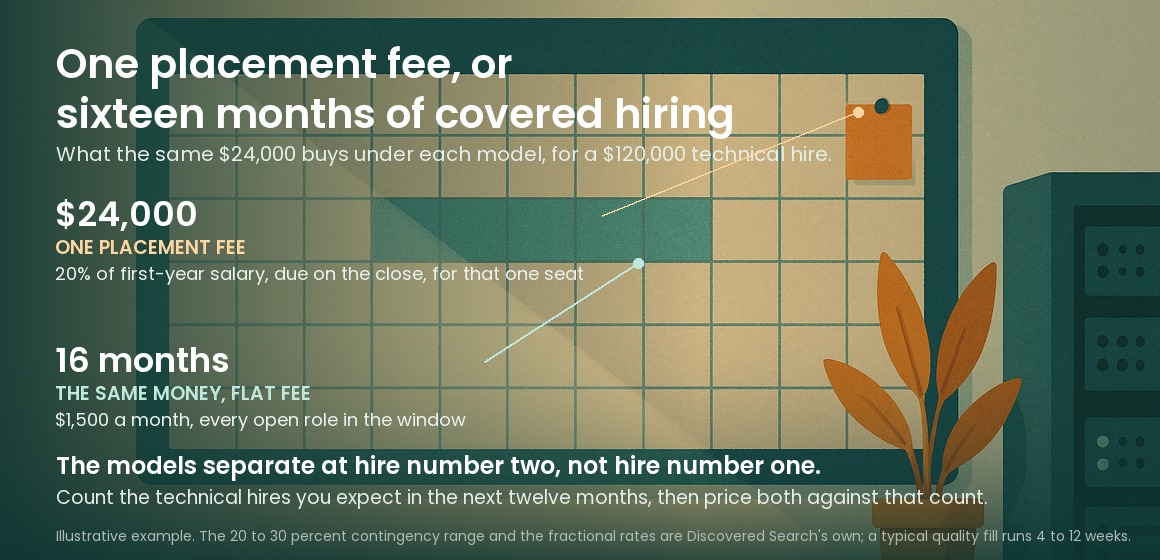
Contingency math is simple. A $120,000 network engineer at 20 percent is a $24,000 fee. At 30 percent it is $36,000. Your own screening effort and your early misses don’t change that number. You pay on the close, which is exactly why speed of submittal wins inside an agency.
Contract staffing has no comparable number. You pay an hourly bill rate, the agency pays an hourly wage, and the margin is the difference multiplied by every hour worked. Ask for both rates before you sign. Without them you can’t tell six weeks of emergency coverage from a year of quiet markup.
Fractional recruiting prices the function instead of the seat. Discovered charges $1,500 a month on a six-month commitment, or $2,500 month to month, with a 30-day money-back guarantee. The same fee covers every open role in that window, which is what makes flat fee recruiting behave differently on hire number two.
| Model | How You Pay | What One Filled Seat Costs | What Happens on the Second Hire |
|---|---|---|---|
| Contingency placement | Percentage of first-year salary, due on hire | 20 to 30 percent of salary ($24,000 at 20 percent on a $120,000 role) | You pay the full fee again |
| Contract staffing | Hourly bill rate; the agency margin is the spread over the pay rate | No single number; bill rate minus pay rate, times hours worked | You keep paying the spread for as long as the tech stays on the agency payroll |
| Fractional recruiting | Flat monthly fee | $1,500 a month on six months, or $2,500 month to month | Covered inside the same monthly fee |
Where the Agency Model Breaks for MSPs
The break happens when your hiring never stops and never speeds up either. A 10 to 100 person managed service provider (MSP) needs one to three technical hires, then another one two quarters later. In between, the need never quite goes away, and the gap costs you aging escalations and slipped project dates.
Most agencies work one requisition at a time and get paid on one event. The close, or the spread. Either way the recruiter earns on speed, and your role competes with every other client’s urgent role on that recruiter’s desk.
Take a Tier 2 service desk seat. You need someone who can work your ticket discipline, write notes a client can read, and escalate to the network team at the right moment. Three fast resumes keep the engagement moving whether or not any of the three has lived in an MSP queue. The sorting, the follow-up and the calibration work come back to you, which is the part the model claimed to take off your desk.
Pausing costs you as well. Revise the role after two interviews, or stop for a busy quarter, and your requisition slides down a list ordered by how fast each one will close.
When no agency and no recruiter owns the work, it falls to whoever has room. Usually that is an HR generalist or the owner. HR people are not recruiters. Making a compliance admin focused HR person do recruiting is like making an accountant do sales.
Questions to Ask Before You Sign
Treat an agency like a vendor that sends candidates and that is what you get. The intake call decides if you bought a hiring process or a resume feed, so ask questions that force a specific answer.
- Who runs first-round screening, and what does that screen cover? Get the length of the call and the checks done before a profile reaches you.
- How many candidates do you screen for each one you submit? A vague answer means you’re funding speed of submittal.
- What makes a resume submit-ready? Ask for the pass criteria in plain words rather than a promise to validate fit.
- Can you tell an L2 ticket-queue operator from a Tier 3 project engineer? They should manage it without you rewriting the job description first.
- What is the replacement window, and what counts as a replacement? Get the clock, the triggers, and who pays when you end the hire for performance.
- If we hire the person later, do we owe a fee anyway? Ask about hire-around language, and about a contractor who resigns and comes back on your payroll.
- For contract to hire, what triggers the conversion fee or the waiting period? Make them state the rule the way it appears in the contract.
A written screening process is the difference between three fast resumes and three candidates who can run in your queue. Ask to see theirs in writing, the way we publish how we screen candidates.
When an IT Staffing Agency Is the Right Call
Sometimes the fee is the cheap option. A service manager resigns on a Thursday and Monday’s queue is already stacked. Paying for speed beats paying for churn, and an agency sells speed on one seat.
Agencies earn their price in four situations.
- Real urgency. Escalations are aging into SLA risk, and coverage this week is worth more than a better fit in two months.
- A hard-to-source seat. Senior niche skills, an odd schedule, a strict location, or a role that is hard to sell.
- Short, defined capacity. A time-boxed project where you need hours rather than a teammate.
- A leadership hire with real downside. A retained process buys reach and a structured search, which is why an executive search runs as a retained process.
The reverse trap costs you as much. Default to agencies because you’re busy and you’ll pay per-hire fees for years rather than build a hiring function your MSP can run. One 20 percent placement fee on a $120,000 role pays for sixteen months of a $1,500 flat fee.
Either way, know what an IT recruiter is supposed to do before you buy one. Keep the role tight, protect interview time on your calendar, and make screening ownership explicit in writing.
Frequently asked questions
How Long Does an IT Staffing Agency Take to Fill a Role?
A typical timeline for a quality hire is 4 to 12 weeks. Need coverage sooner and you’ll get a push toward contract staffing or contract to hire, because starting someone quickly beats closing a direct placement on time.
What Does an Agency Replacement Guarantee Usually Cover?
It’s usually a narrow window tied to the close, and it often covers only a voluntary departure. Get the clock, the triggers, and who pays when you end the hire for performance. Ask for it in the agreement rather than in the email thread.
When Do You Owe a Conversion Fee in Contract to Hire?
You generally owe it when you bring the contractor onto your W-2 payroll before a defined milestone, and you may avoid it after a stated waiting period. Don’t accept a promise to work with you. Make the agency state the exact rule in the contract.
What Is a Hire-Around Clause?
A hire-around clause says you still owe a fee if you hire the candidate indirectly, for example after they resign and you rehire them, or through another entity. If you use contractors as a tryout path, find out how long that obligation lasts and which actions trigger it.
Is Fractional Recruiting Cheaper than an Agency?
It depends entirely on how many hires you make. For a single hire, one contingency fee can be the simpler purchase. Across two or three hires a year, a flat monthly fee covers every open role for less than one 20 percent placement fee on a $120,000 salary.
If fractional looks right on paper and you want to test it against your own hiring plan, schedule a 30-minute call with Discovered and we’ll run the numbers with you.