You’re two weeks into a Tier 3 service tech search. Four hundred applications, none of them right, and the ticket queue keeps climbing.
An owner usually asks at that point what an IT recruiter does that a job post doesn’t. It’s also the moment the 20 to 30 percent placement fee starts to look either reasonable or absurd, depending on how the last search went. This article covers what a good IT recruiter does for a 10 to 100 person managed service provider (MSP), what one costs under each of the four ways to pay, when you need one, and when you don’t.
What an IT Recruiter Does
A job post collects applications. An IT recruiter creates qualified conversations and then keeps them moving while you run delivery.
For an MSP, the work starts with translating the seat into a search plan. A Tier 3 service tech isn’t a sysadmin, and an L2 help desk hire isn’t a network engineer. A recruiter who has done IT hiring asks in week one the questions you’d otherwise discover in week three. Which tools will the person touch, what does the on-call rotation look like, and what would make you say no in the first five minutes?
Then they do the work you don’t have time to do consistently.
- Source beyond job boards. They reach people who aren’t applying anywhere, for roles like L2/L3 help desk, Tier 3 service tech, sysadmin, network engineer, cloud engineer, security engineer, service manager, and vCIO.
- Screen for the real role. A keyword match on a resume is where their work starts. A phone screen against the actual job is where it earns its fee.
- Control speed. They schedule, keep candidates warm, and reset expectations when your interviews slip. If a client escalation pushes your Tuesday calls to Friday, they make sure the good network engineer hasn’t accepted somewhere else by then.
- Handle references and the close. Reference checks, objections, and offer coordination, so the last step doesn’t turn into a week of back-and-forth.
You still make the hire. The recruiter owns the cadence and the busywork. A good one also brings structure to the evaluation itself, so you’re scoring the same things on every candidate. Integrity comes first, then attitude, then cognitive ability, then personality.
Why MSP Hiring Stalls Without One
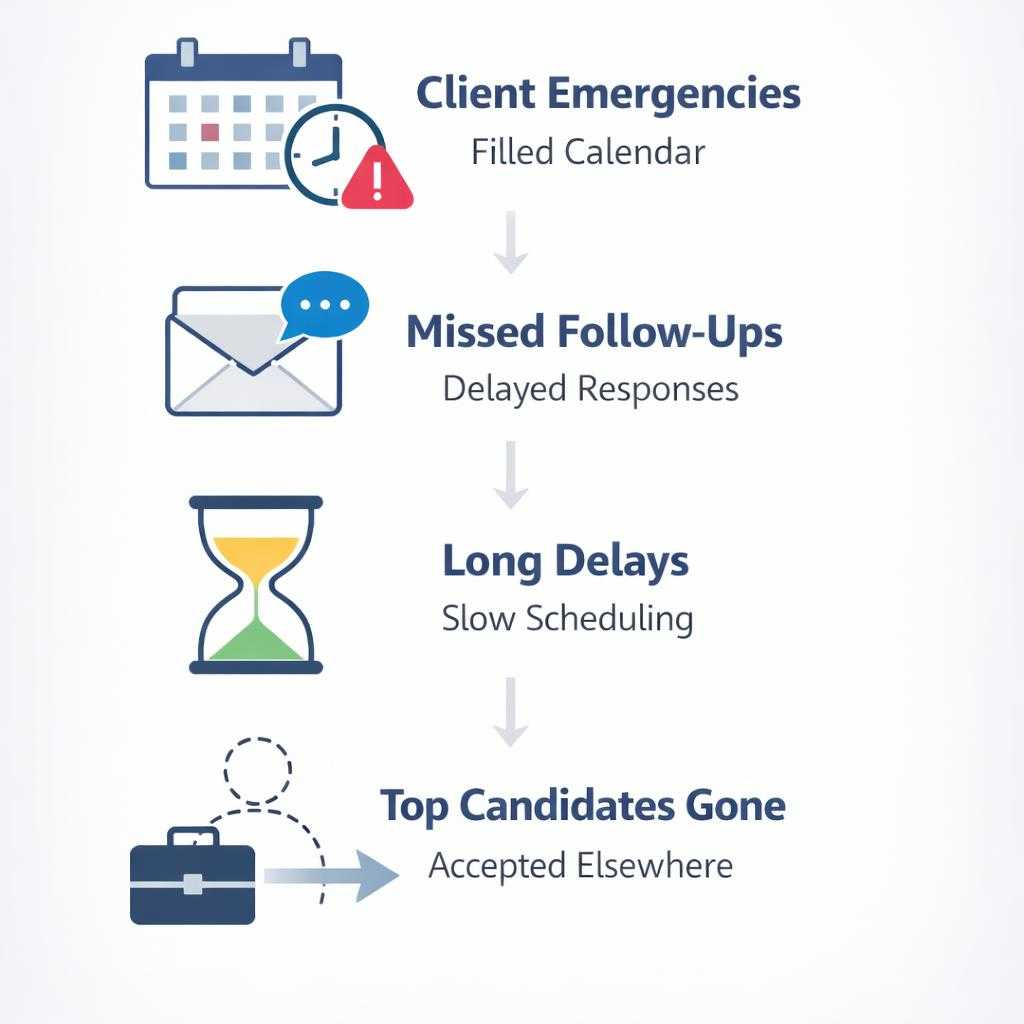
It looks like a candidate problem. The bottleneck is your calendar.
Recruiting needs daily cadence, and an MSP owner’s day is already spoken for by clients and on-call. When delivery flares up, you miss a morning of follow-up, then a day, then a week. The best candidates don’t wait while you clear an escalation.
The pattern is familiar. You screen three resumes on Sunday night and plan to call them Monday. A Tier 3 issue blows up, and the calls slide to Wednesday. By then the qualified network engineer has accepted another offer, and you’re interviewing the people who were available rather than the people who were right.
When an HR generalist runs the search instead, the pattern changes and the outcome doesn’t. Other HR work crowds out outreach, so the search collapses into inbound volume and keyword filtering. That’s how you end up with 400 applicants and zero real matches for an L3 role. As Fletcher Wimbush puts it, HR people are not recruiters. Making a compliance-focused HR person do recruiting is like making an accountant do sales.
One question tells you whether you have this problem. Can someone on your team respond to a good candidate within a day, every time? If the answer is no, expect slow scheduling, long gaps between steps, and “almost” candidates reaching late-stage interviews because the funnel is never full.
What an IT Recruiter Costs Under Each Model
You’re buying more than effort. You’re buying an incentive system and a spending pattern, and the four models differ more on those than on price.
In one phrase each. An in-house recruiter is a salary whether or not you’re hiring this month. Contingency is a percentage of first-year salary, paid only when someone starts. Retained search is a committed engagement for leadership and hard-to-fill roles. Fractional recruiting is a flat monthly fee that covers every open role for as long as the engagement runs.
Here’s what each usually means in dollars, using a $120,000 network engineer as the reference point.
| Model | How You Pay | One $120,000 Hire | Three Hires in a Year | Best Fit |
|---|---|---|---|---|
| In-house recruiter | A full salary, whether or not you’re hiring this month | No clean per-hire number; the salary runs all year | The same salary, spread over three hires | Steady, continuous hiring with enough open roles to keep one person busy |
| Contingency | 20 to 30 percent of first-year salary, paid on placement | $24,000 to $36,000 | $72,000 to $108,000 | A one-off role where you’ll accept a higher per-hire cost for zero fixed spend |
| Retained search | A committed fee for the search, typically higher than contingency | Varies by agreement | Varies; each search is its own engagement | Leadership and rare-specialist seats that need a dedicated, confidential process |
| Fractional | Flat monthly fee covering every open role | $1,500 a month on a six-month commitment, or $2,500 month to month | The same monthly fee, even with several searches running | Hiring in bursts, two or more technical hires a year, and a need for predictable spend |
The difference appears the moment two roles are open at once. Under contingency, the meter starts over for each hire. Under fractional, you’ve bought capacity across every open seat, which is why comparing it to a single placement fee undersells it. If you’re hiring an L3 help desk tech and a service manager in the same quarter, a flat monthly model keeps both searches moving without doubling the spend.
To sanity-check the numbers for your own plan, map the next twelve months of hiring as “one role at a time” or “bursts,” then compare a single contingency fee to the monthly model using what fractional recruiting costs and fractional versus contingency. For most teams doing real recruiting for MSPs, predictability matters as much as price.
When to Pay for Recruiting Help, and When to Skip It
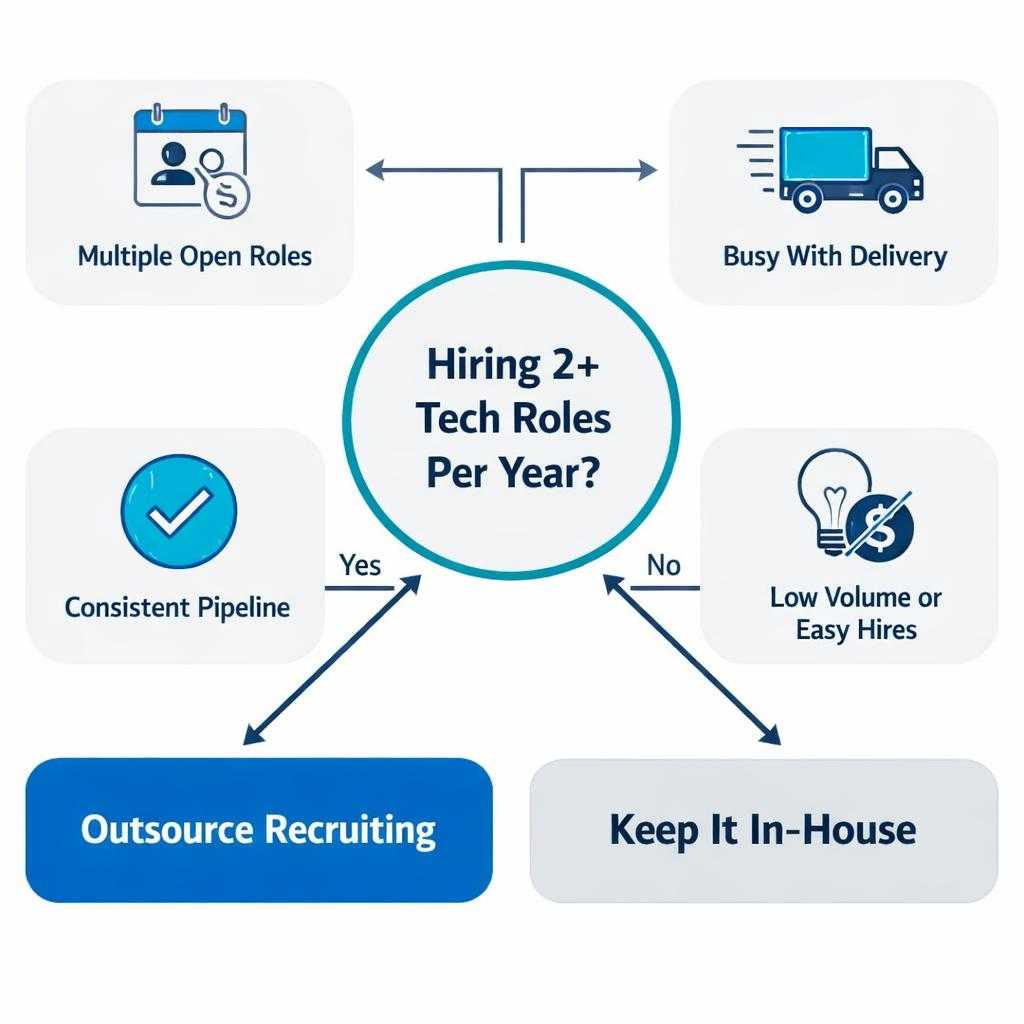
Bring in a recruiter when hiring speed has become an operations risk. If you hire two or more technical people a year, or your hiring arrives in bursts after a client win, you need someone who can source daily, screen fast, and keep candidates moving while you run delivery.
Skip it when the volume is low or you have a reliable shortcut. One hire every couple of years, a role you can fill from your own network, or a leadership seat that belongs with retained search. None of those need a monthly fee. The trap is the middle ground, where you tell yourself you’ll post the role and work the inbox at night. That’s the slowest channel with the highest interruption cost, and your service manager feels it first in the schedule.
What to Ask Before You Sign
A recruiter who sounds sharp on a kickoff call can still cost you a month. If they pitch three network engineers who have only done internal IT, you’ll spend your own nights untangling scope, on-call expectations, and client-facing pressure, and then you’re back to zero. Before you agree to anything, ask these four questions.
- Which MSP roles have you filled recently (L2/L3 help desk, Tier 3 service tech, sysadmin, network engineer, service manager, vCIO), and what made those candidates a fit?
- How do you screen technically for this specific role before you book time on my calendar?
- What happens if the hire leaves within 90 days?
- What does your fee cover in plain language? Sourcing, screening, scheduling, references, and the close, or only introductions?
The answers tell you whether you’re buying a process or a resume feed. If you want the longer version, how to choose a fractional recruiting partner walks through seven questions in detail.
Frequently Asked Questions
What does an IT recruiter do?
An IT recruiter sources candidates, including people who aren’t applying anywhere, screens them against the actual role, keeps scheduling and follow-up tight, and runs references and offer coordination so good people don’t go dark. For an MSP, a good one can tell the difference between an L2 help desk hire and a Tier 3 service tech, so you waste fewer interviews.
How much does an IT recruiter cost?
It depends on the model. Contingency usually runs 20 to 30 percent of first-year salary, so a $120,000 network engineer at 20 percent costs $24,000 for that one hire. Fractional is a flat monthly fee that covers every open role, typically $1,500 a month on a six-month commitment or $2,500 month to month, with a 30-day money-back guarantee.
Is an IT recruiter worth it for a small MSP?
Yes, when the person doing the recruiting today isn’t a recruiter and can’t keep next-day response times while running delivery. If you hire two or more technical people a year, a flat monthly model can cost less than one contingency placement and covers every open seat at once.
How long does it take an IT recruiter to fill a role?
A quality hire typically takes 4 to 12 weeks, depending on the role. The biggest difference shows in the first two weeks, when consistent sourcing and screening cadence fills the funnel. If your screen, interview, and offer steps stall week to week, the timeline stretches no matter how many resumes you have.
What is the difference between an IT recruiter and a staffing agency?
A staffing agency usually places contract or temporary workers and marks up their hourly rate. An IT recruiter fills permanent seats on your team. Within recruiting, the models differ on incentive: contingency recruiters are paid only on placement, while retained and fractional recruiters are paid to run the process. Match the model to your reality, whether that’s one hard leadership seat or several roles that open in bursts.
If fractional looks right on paper and you want to test it against your own hiring plan, schedule a 30-minute call with Discovered and we’ll run the numbers with you.