
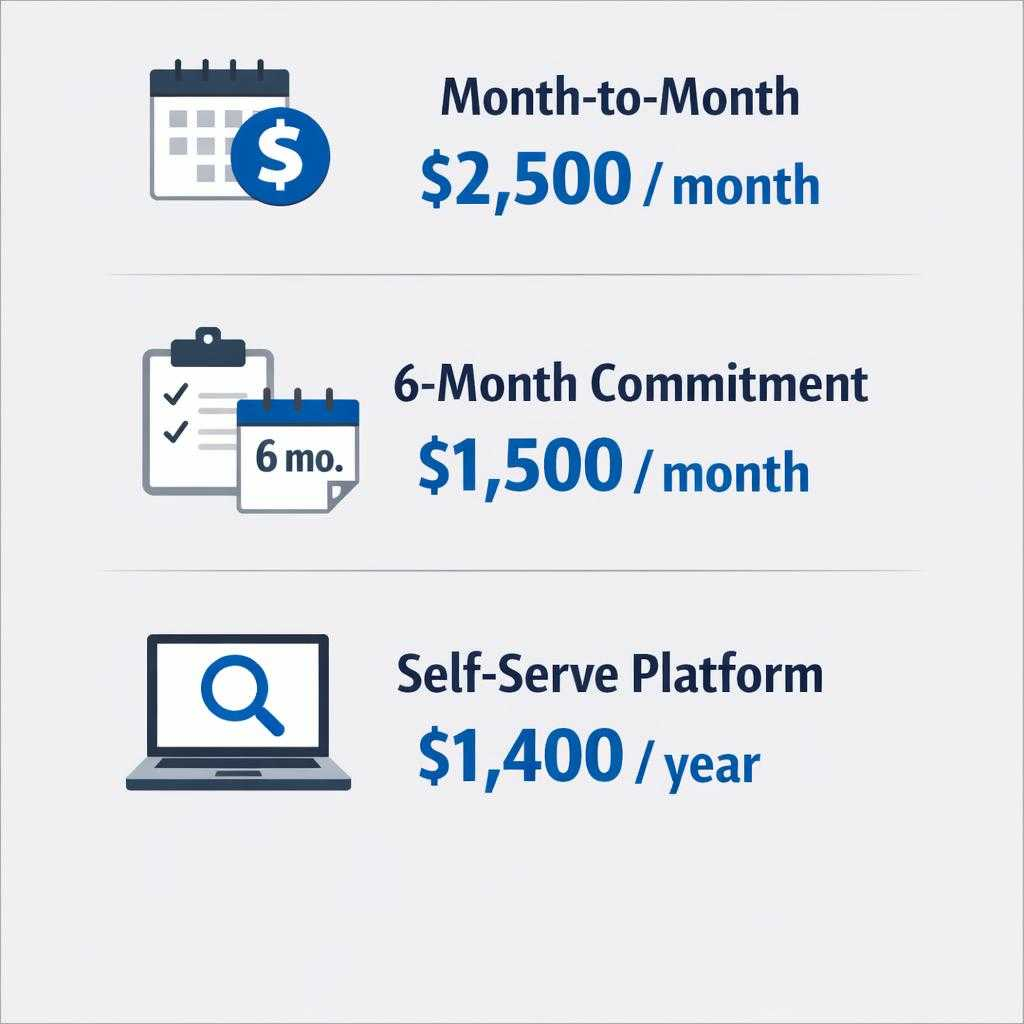
You’re pricing your next hire and wondering what fractional recruiting cost comes out to. In 2026, expect three clear price points:
$2,500/month month-to-month
$1,500/month with a 6-month commitment
$1,400/year if you DIY with a self-serve platform
If you’ve already paid a 15% to 25% contingency fee once, the real question is what hire two costs. This guide gives you the three price points and the break-even math against a $24,000 contingency fee on a $120,000 role, plus what should be included so you can compare apples to apples and budget recruiting like a predictable line item instead of an $18,000 to $30,000 contingency fee.
Fractional Recruiting Cost: The 3 Price Points
A founder gets two quotes that both claim to be “fractional,” one reads like a part-time sourcer, the other reads like someone who will run the whole hiring motion. The price difference only makes sense once you separate the models you’re buying.
When you see “fractional recruiting cost” online, you’ll get wildly different numbers because people lump hourly contract sourcing and embedded recruiters into the same bucket, which is why fractional recruiting pricing is hard to compare at a glance. For planning purposes, use three distinct pricing models, each buying you a different mix of ownership and cost predictability.
1. Fractional recruiting service (month-to-month): $2,500/month. This fits when hiring comes in bursts or you don’t want a long commitment. You’re paying for consistent weekly recruiting capacity without the 20% contingency incentive to “close” a borderline candidate.
2. Fractional recruiting service (6-month commitment): $1,500/month. This is the lower monthly cost option when you know you’ll hire steadily across a season, expansion, or backlog. Case in point, if you run an MSP or construction firm and you’re planning multiple hires across ops and frontline roles, the commitment is what makes budgeting clean.
3. Self-serve hiring platform: $1,400/year. This is for teams under 50 employees that want to run recruiting themselves but need an ATS and interview scorecards to keep it from eating leadership time.
A quick check: if you’re filling 2+ roles per quarter, you usually don’t need “cheaper,” you need a steady flow of qualified candidates.
If you want a simpler way to budget recruiting than percentage fees, flat-fee models can make monthly spend far more predictable across multiple hires. Read more in our article: Flat Fee Recruiting
Break-even math vs contingency fees
A 15% to 25% contingency fee looks tidy on paper, but it resets on every placement. On a $120,000 role, that’s $18,000 to $30,000 per hire, and the economics get louder starting with hire two.
“Only pay when you hire” sounds low-risk, but the real choice is whether you want one-off placements or an operating system that runs weekly. Once hiring becomes repeatable, percentage fees function like a recurring tax on every $100K+ placement.
Use the common benchmark: a $120,000 software engineer at a 20% contingency fee. That’s $24,000 per hire. Now compare it to a flat monthly fractional fee where you can run multiple roles through the same recruiting motion.
| Model | What You Pay | Cost After 1 Hire | Cost After 2 Hires | Break-even Takeaway |
|---|---|---|---|---|
| Contingency recruiting | 20% of $120,000 | $24,000 | $48,000 | Stays linear. Every hire re-triggers the full fee. |
| Fractional (month-to-month) | $2,500/month | ~$2,500 to $30,000 (depends on months engaged) | Still $2,500/month | Beats contingency once your total months on service stay under ~9.6 months per hire cycle, which is why it usually wins starting with hire #2. |
| Fractional (6-month commitment) | $1,500/month | $9,000 | $9,000 | Beats contingency on hire #1 as soon as you’re actually hiring during the commitment. |
What you should do with this: map your hiring plan into “months you’ll truly be recruiting,” not calendar months. If you expect two hires in the next six to nine months, contingency is the expensive option by default, and you should demand a better reason than “it’s what we’ve always used.”
What’s Included vs Extra Costs
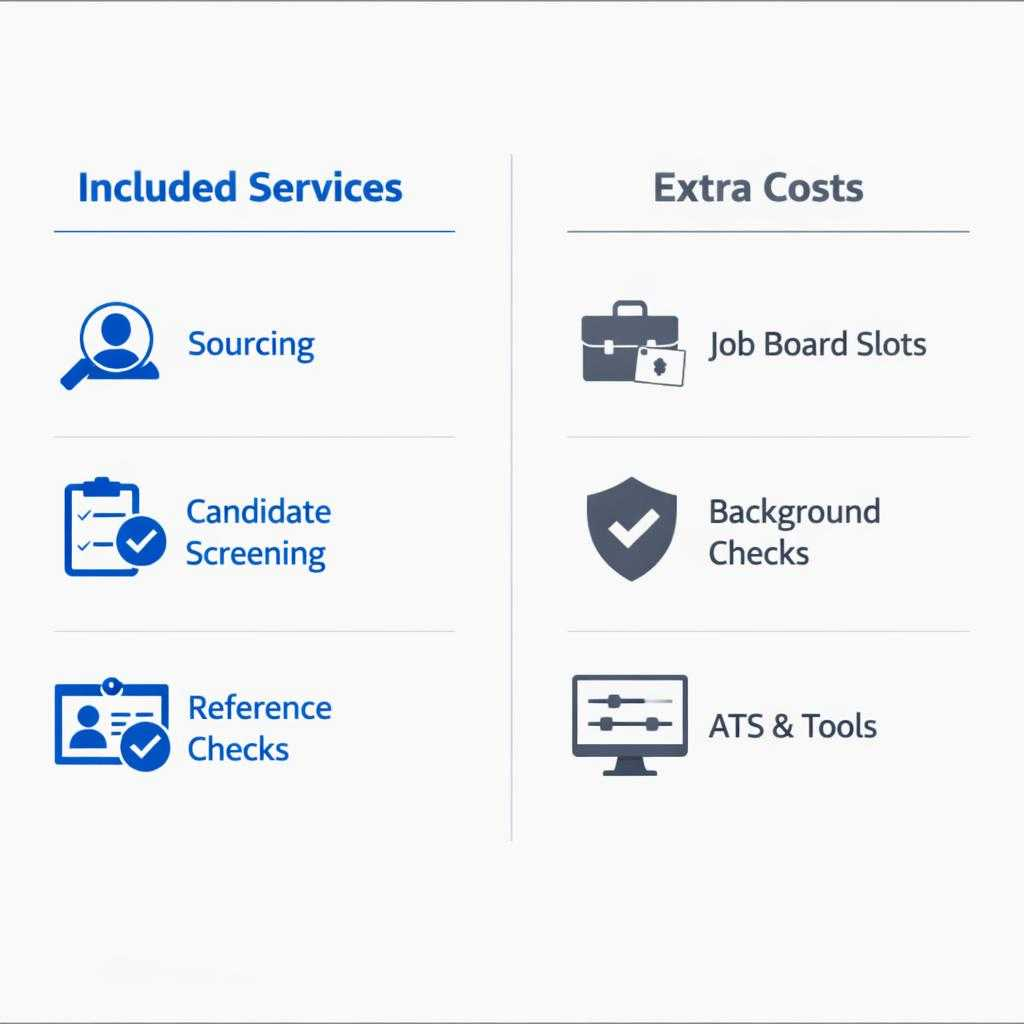
Don’t assume the monthly fee means “everything,” or you’ll find out later that job slots, background checks, and tooling are billed separately. The fastest way to blow up the ROI is to discover too late that ownership stops halfway through the process.
A real fractional recruiting fee should cover full-cycle work: sourcing, screening, and reference checks. If any of that gets labeled “optional,” you’re buying partial capacity that still leaves you holding the bag.
The surprise line items are usually outside recruiter labor. For instance, you may still pay Indeed job slots and Checkr background checks, or an ATS and sequencing tools if they aren’t included. Before you sign, ask for an SOW that separates included services from billed-separately tools and vendors so your monthly cash outlay stays predictable. A useful checklist of common pass-through tooling costs shows up in most RPO cost guides, and the same items map cleanly to what you should verify in any fractional quote.
Which Model Fits Your Hiring Volume
When the model matches your volume, recruiting stops feeling like a scramble or starts running like an operating rhythm. You get fewer stalled requisitions, fewer dropped candidates, and far less leadership time burned on coordination.
Start by asking if you have enough hiring motion to keep a recruiting engine warm. A flat monthly fee only feels “expensive” if you treat each role like a one-off event. At 2+ roles per quarter, the purchase isn’t a single hire. It’s throughput, so your budget should reflect an ongoing motion.
If your hiring comes in bursts, month-to-month fractional at $2,500 works when you can clearly name the next 30 to 90 days of roles and you’ll stay responsive. For example, an MSP that needs a Tier 2 helpdesk tech and a vCIO-adjacent role can run both at once, as long as you keep the scorecard consistent and don’t disappear into a P1 outage for two weeks. The cost control lever here isn’t negotiating the fee, it’s limiting active roles and making fast decisions so you don’t “idle” the month.
For MSPs, recruiting speed and quality often comes down to having a consistent weekly process for sourcing, screening, and keeping candidates warm while you handle tickets and client work. Read more in our article: Msp Recruiting
If you can see steady hiring ahead, the 6-month commitment at $1,500/month is the cleanest fit because it turns recruiting into a predictable line item you can plan against. In construction, that often shows up as a season where you need a project manager and a superintendent. You don’t want four separate 20% fees. You want one consistent weekly operating rhythm that keeps candidates moving and keeps your foreman and PMs from doing phone screens between job sites.
If you’re under 50 employees and you mostly need repeatable roles filled with a clear scorecard, self-serve at $1,400/year makes sense when you’ll actually do the work and you mainly need structure and tools. Where founders get it wrong is thinking “we’ll just DIY” while also expecting the same funnel quality you get from a dedicated owner. DIY isn’t free, it just invoices you in calendar time.
IT note: Fractional is ideal for MSPs and operator-led SaaS when you need full-cycle ownership on technical screens and candidate follow-up, especially when weighing RPO vs fractional recruiter. If your technical leads can only reliably give you two 30-minute blocks a week, you’ll get more ROI from a model that runs sourcing and scheduling than from paying an agency to email PDF resumes and hoping your team books the debrief and sends accept or reject updates.
FAQ
How Much Does Fractional Recruiting Cost?
For a full-service fractional recruiting program, plan on $2,500/month month-to-month or $1,500/month with a 6-month commitment. If you want to run recruiting yourself with tools and process, the self-serve option is $1,400/year for companies under 50 employees.
Is Fractional Recruiting Cheaper Than Hiring An Internal Recruiter?
Usually, yes, unless you have enough steady volume to keep a full-time recruiter fully loaded year-round. Once you add salary and benefits, the cost of hiring an in-house recruiter often comes out higher than a $1,500 to $2,500 monthly line item, especially if you’re hiring in waves.
Is There A Minimum Engagement?
Month-to-month has no long-term commitment, and the commitment option is 6 months at the $1,500/month rate. The right choice is less about “minimums” and more about whether you can name the roles you’ll actively run in the next 30 to 90 days.
What If I Only Need To Hire One Person?
Fractional can still win financially when that one hire would trigger a 15% to 25% contingency fee on a $100K+ role. If your hiring is truly one-off and uncertain, use month-to-month so you’re only paying during the months you’re actually recruiting.
What’s The Risk If It Doesn’t Work?
The first-month risk is capped by the 30-day money-back guarantee, so you can validate the working rhythm without committing to a big upfront spend. Treat that month like a trial of execution: do you see real weekly activity and fewer founder hours disappearing into coordination?
Tracking a few simple KPIs like time-to-fill, interview-to-offer ratio, and 90-day retention makes it easier to spot whether a recruiting model is actually improving outcomes. Read more in our article: 9 Essential Metrics To Track Hiring Success Retention
Related reading: Fractional Recruiting vs Contingency · Fractional Recruiting vs RPO · How to Choose a Fractional Recruiting Partner
If your math is pointing at fractional but you want to pressure-test the numbers against your specific hiring plan, schedule a 30-minute call with Discovered. We’ll run it with you and show you whether the model actually fits.