
You paid $48,000 in contingency fees last year, and you’re about to do it again. You’re not crazy for using contingency; it works for true one-off hires. Hiring more than occasionally exposes contingency’s compound problem. Percentage fees stack with every placement, and the model rewards closes over scorecard fit.
In this guide, you’ll see how fractional and contingency models change the recruiter’s day-to-day work. You’ll see why the contingency fee structure pushes recruiters toward fast closes over right-fit picks. You’ll also run the simple break-even math where the economics usually change at hire #2 in a quarter, and you’ll get a clear way to decide whether a month-to-month fractional setup fits your hiring pace better than another round of “no hire, no fee.”
Fractional Recruiting vs Contingency: The Real Difference
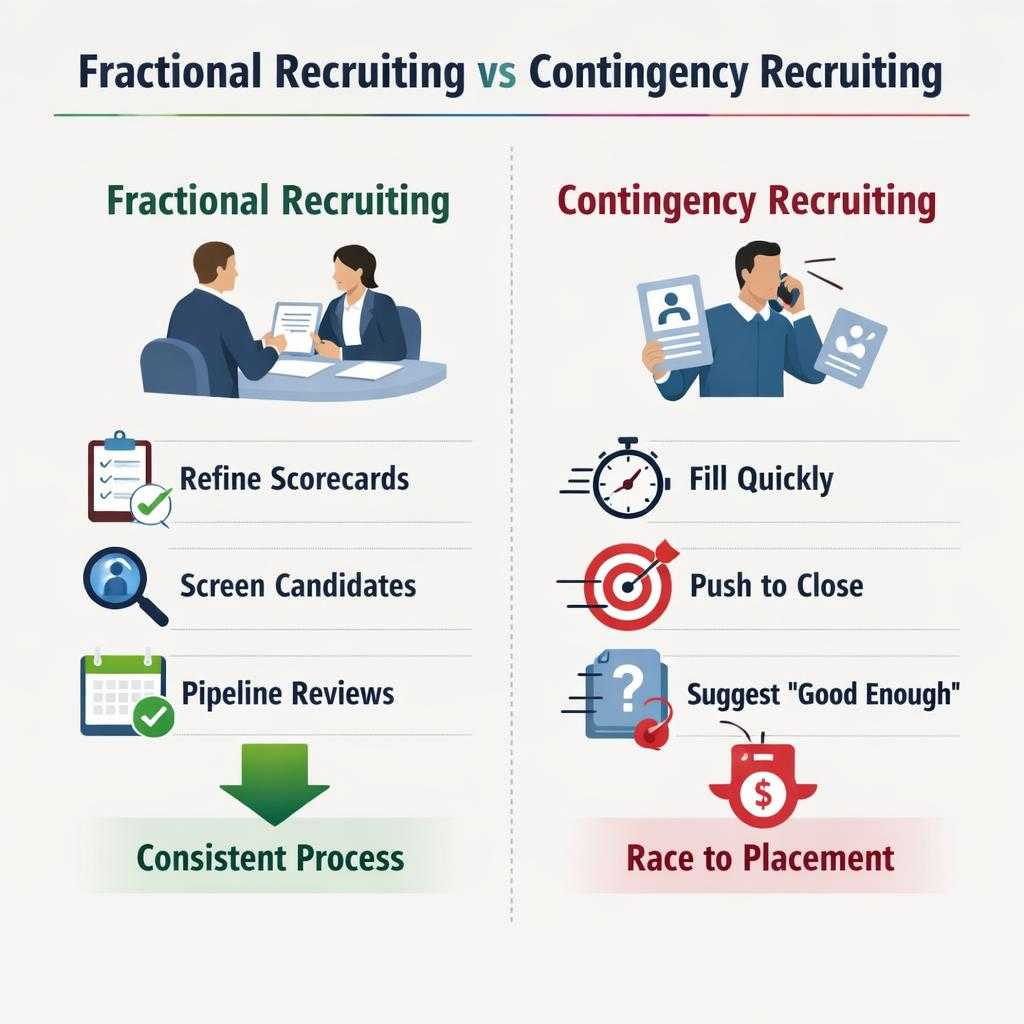
| Dimension | Fractional recruiting | Contingency recruiting |
|---|---|---|
| Cost structure | Flat monthly retainer for consistent capacity | Percentage of first-year salary per hire (often 15% to 25%) |
| Incentives | Paid for process and outcomes over time, not a single start date | Paid when a candidate starts, so work concentrates on roles most likely to close fast |
| Time-to-fill | Can be fast when you run a steady weekly cadence | Can be fast, but speed often comes from pushing what is easiest to close |
| Scope of work | Sourcing, screening, scheduling, process management, and closing support | Candidate delivery and placement focus, with less emphasis on end-to-end process |
| Between hires | Keeps pipeline, scorecards, and interview loop tight between candidates | Typically pauses until there is a fee-linked placement to pursue |
| Predictability | More predictable spend during active hiring months | Variable spend that spikes per placement |
| Candidate quality bar | Easier to hold non-negotiables because there is less pressure to force urgency | Higher pressure to keep activity moving toward a close, which can surface borderline candidates |
| Risk if it does not work out | You can adjust month-to-month based on hiring pace | You can still pay a large fee per hire, plus risk of restarting a search if it does not stick |
The real difference isn’t the invoice, it’s what the fractional recruiter does all day because of how they get paid. In contingency, the recruiter earns when a candidate starts, so the work naturally concentrates on roles most likely to close fast and on candidates most likely to accept. That’s not immoral, it’s math. If you’ve ever felt subtly rushed to “just interview them,” you’ve seen the model at work.
Fractional changes the operating behavior. You’re paying for consistent capacity, so the recruiter can spend Tuesday tightening the scorecard with your foreman and ops lead, Wednesday rebuilding the outreach list for a project manager search, and Friday running debriefs so interview feedback doesn’t stall. For instance, an MSP hiring a dispatcher and a Tier 2 tech in the same quarter benefits more from one person running weekly pipeline reviews and screening than from two separate fee-driven sprints.
The “we only pay if we hire” pitch sounds like low risk, but it often just hides where you’re actually paying: in rushed decisions, repeated searches, and owner and PM time spent herding the interview loop and next-step scheduling.
Fractional models work best when you treat recruiting like an operating cadence: weekly pipeline reviews, tighter scorecards, and consistent outreach volume. Read more in our article: Fractional Recruiting
Where the Math Changes at Hire #2
If hiring is truly occasional, contingency can feel safer because you only get billed after a start date. But the fee is a percentage, not a price, and recruiting agency fees stack fast once you commit to a second role in the same quarter. Case in point: a $120,000 hire at a typical 20% fee is $24,000, and at 25% it’s $30,000. That’s before you’ve paid for the next req.
A typical fractional engagement runs $1,500 to $2,500 per month: $2,500 month-to-month or $1,500 with a six-month commitment. Six months at the committed rate puts you at $9,000 total, less than half of one $24,000 contingency placement on a $120,000 hire. The moment you add hire #2 inside that same window, you’ve shifted from paying twice to paying once.
To illustrate this in an operator-led business: if you’re a construction firm hiring a superintendent and a project coordinator, contingency can easily turn into $50,000 to $60,000 in fees on two mid-market salaries. A fractional engagement over the same 2-month stretch lands at $3,000 to $5,000 instead, and you also get the between-candidates work that contingency rarely prioritizes, like cleaning up the scorecard and tightening the interview plan.
To test the break-even, multiply expected hires in the next 90 days by typical salary by 15% to 25%. Compare the result to your fractional monthly fee times the months you’ll actually use. If the left side is already bigger by hire #2, the “we only pay if we hire” line isn’t reducing cost, it’s delaying the invoice.
Flat monthly pricing can remove per-hire fee stacking and makes it easier to budget recruiting capacity across multiple roles in the same quarter. Read more in our article: Flat Fee Recruiting
Incentives and Candidate Quality
On Monday you get five resumes that look “good enough,” and by Friday you’re wondering how you’re still unfilled after three interviews. The pattern usually isn’t your standards, it’s the incentive structure behind the candidate flow.
In contingency, the recruiter’s payday is tied to a start date, so their rational move is to optimize for what closes. That usually tilts the process toward speed and readily available candidates, and it can compress the interview loop and next-step scheduling. You can have a perfectly professional contingency recruiter and still feel a weird push to “get them in front of your foreman and ops lead” before you’ve even agreed on what good looks like.
Under that pressure, you can get borderline candidates that are credible enough on paper to keep things moving. For example, you ask for a project manager who can run owner meetings and keep subs on schedule, and you keep seeing resumes that look fine on paper but fall apart the moment you probe for field coordination, change-order discipline, or conflict management. The model didn’t create bad intent; it created a bias toward activity that might convert into a fee.
Fractional changes the default behavior because the recruiter gets paid the same whether you hire in 3 weeks or 7. That removes the incentive to manufacture urgency and makes it easier to hold the line on non-negotiables like a scorecard and structured screens. If you’re honest, a lot of “we can’t be picky” moments are really “we don’t have the bandwidth to run the process,” and a fee can’t fix that.
Watch for these signals that incentives are dragging quality down:
-
You’re getting a high volume of resumes, but few make it past a role-specific screen.
-
The recruiter keeps steering you back to “interview anyway” instead of tightening the spec.
-
You’re moving fast but still restarting searches because the hire doesn’t stick or can’t perform.
A practical move: before you approve another round of interviews, force a five-minute reset. Ask, “What would make this a no in week two on the job?” then turn those into two or three screening questions you insist on every time. If the recruiter resists that structure, you’re not buying recruiting, you’re buying momentum.
Structured screening and clearer scorecards usually show up as better downstream retention, not just faster time-to-fill. Read more in our article: 9 Essential Metrics To Track Hiring Success Retention
The Hidden Costs Founders Feel
You think you’re buying speed. What you usually get is the coordination work. You still handle scheduling, follow-ups, and keeping the process moving. If you have ever lost a candidate because a next step sat for a week, you have already paid for this in time.
Hiring leads choose contingency for the time it saves them. DIY recruiting eats the week: clarifying the role, screening, and repeating the same context to every outsourced recruiter involved. By the time you’re back in your inbox at 10 p.m., “send me candidates” feels cheaper than rebuilding a hiring system.
This is also why the work falls on your office manager or compliance-first HR admin. As Fletcher Wimbush puts it, “HR people are not recruiters. Making a compliance admin focused HR person do recruiting is like making an accountant do sales.” In a 30-person construction company, that looks like your office manager trying to run background checks, new-hire paperwork, and also source a superintendent while your PMs send interview feedback three days late.
The trap is that contingency doesn’t remove the workload, it just shifts it into coordination and fast decision-making. You still carry role tradeoffs and fast feedback: making tradeoffs on the role and keeping your foreman responsive enough to close. For instance, an MSP owner might get a stack of Tier 2 resumes fast, but lose two good candidates because the technical screen happened a week after the recruiter teed it up.
If you want to quantify the hidden cost before you sign another fee agreement, look at your own behavior over the last 30 days: how many hours did you spend context-switching on hiring, and how many days did candidates sit without a next step? If your answer is “too many,” you’re not really buying recruiting with contingency, you’re buying a momentary sense of coverage.
FAQ
Is Fractional Recruiting More Expensive Than Contingency?
Not if you’re doing more than one hire in a short window. Contingency typically runs 15% to 25% of first-year base salary per hire, so the second placement is where the total usually passes a flat monthly fractional fee.
Will My Contingency Recruiter Still Get Paid If I Switch?
Maybe, depending on your agreement’s candidate ownership terms and any guarantee window (often 30 to 90 days). Before you pause or replace an agency, ask for the ownership period in writing and make sure you understand what happens if you hire someone they introduced.
What If We Only Hire 1 Person a Year?
Contingency can be the right call for true one-off hiring, especially if it’s a hard-to-find senior role. For high-stakes executive placements, you may also want to compare against retained executive search options.
How Long Does a Fractional Engagement Need to Be?
Plan for a real push, not a two-week experiment, even with month-to-month recruiting services. Most teams see the model work when you commit to at least 8 to 10 weeks of consistent weekly cadence, and many fractional setups can run month-to-month so you can scale up during hiring and down between hires.
Related reading: Fractional Recruiting vs RPO · Signs You’ve Outgrown Contingency Recruiting · Fractional Recruiting Cost in 2026
If you’ve paid for two contingency placements in the last 12 months, you’ve already paid the cost of switching. Schedule a 30-minute call with Discovered and we’ll show you what your next year of hiring would cost on the fractional model.