
You outgrew contingency recruiting, and now you’re staring at two options that sound interchangeable: fractional recruiting and RPO. They aren’t. RPO is built for sustained, high-volume hiring with deep integration and longer commitments, while fractional is built for lumpy 5–30 hires per year with month-to-month flexibility and a clean off-ramp.
The catch is that most pitches make them look like the same service with different wrappers, so you end up optimizing for the monthly minimums and exit terms: headline price instead of utilization and contract risk. This breakdown will help you choose the model that fits your real hiring plan, not the one that sounds more “serious” in a sales call.
Fractional Recruiting vs RPO: The Real Difference
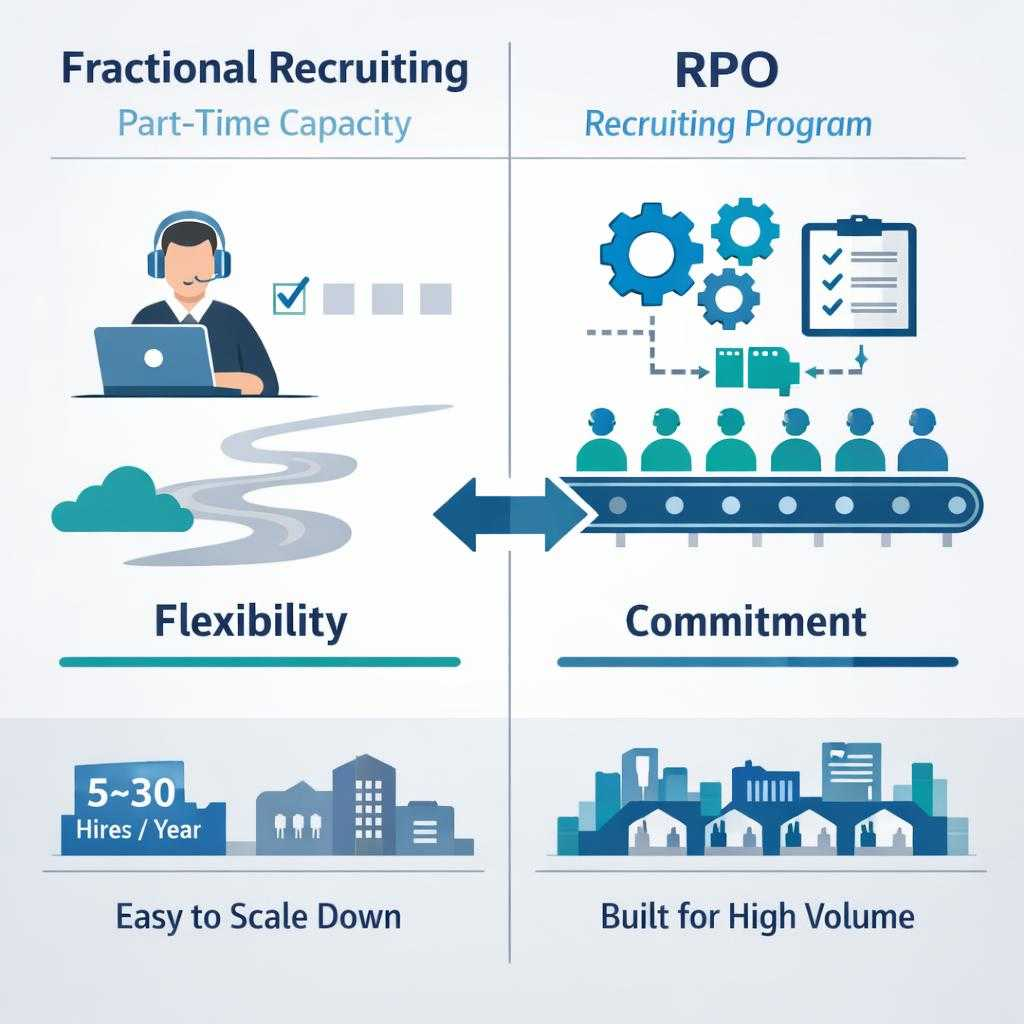
| Dimension | Fractional recruiting | RPO (Recruitment Process Outsourcing) |
|---|---|---|
| Best-fit hiring volume | 5–30 hires/year; lumpy quarters | 50+ hires/year; sustained waves |
| Concurrency fit | Works when few reqs are live at once | Wins when 10+ reqs stay live for long stretches |
| Cost structure (common) | $1,500–$2,500/month flat retainer; month-to-month or 6-month commitment | $3,000–$10,000 per hire or $8,000–$15,000/month per embedded recruiter (often add-ons) |
| Commitment / contract | Month-to-month; clean off-ramp | Longer commitments; minimums are common |
| Ramp-up time | Fast ramp up and down | Slower ramp; program setup period |
| Integration depth (ATS/HRIS) | Light to moderate | Deeper integration is typical |
| Delivery model | Part-time recruiter capacity; lighter governance | Program model with heavier process, tooling, and governance |
| Reporting cadence | Lighter, operator-level check-ins | More formal reporting and program governance |
| If hiring slows or pauses | You can flex down or stop more easily | You often still pay minimums or monthly fees; renegotiation may be needed |
| What you are really buying | Capacity with flexibility | Capacity plus governance and a recruiting engine |
Fractional and RPO are not interchangeable, even though buyers often shop them the same way. The real choice is what operating model you’re buying: fractional usually buys you part-time recruiter capacity with light integration and an easy off-ramp; RPO usually buys you a program with heavier process, tooling, and governance that expects sustained volume.
The question that keeps teams out of trouble is whether you’re trying to cover recruiter bandwidth for an uneven, stop-start hiring plan, or stand up a recruiting engine that can run at high utilization for a long stretch. Without a confident forecast of steady hiring, a long RPO commitment can turn into paying for capacity you don’t use. And when throughput needs to be consistent, running fractional as “just add a few hours” falls apart the moment multiple roles go live at once.
The Comparison That Actually Decides It
A COO signs an RPO statement of work thinking they bought recruiting output, then discovers they also bought meetings, workflows, and tool access rules they are not staffed to run.
Don’t let the pitch deck labels drive the decision. Compare them by what you’re committing to: capacity and governance (RPO) versus capacity with an off-ramp (fractional). In practice, RPO pricing often lands at $3,000 to $10,000 per hire or $8,000 to $15,000 per month per embedded recruiter, sometimes with LinkedIn Recruiter seats billed separately. Fractional commonly shows up as $1,500 to $2,500/month for typical mid-market coverage, with month-to-month and 6-month commitment options, so pin down the structure before you compare.
Utilization is the real decider. Uneven demand can leave you either paying for idle RPO capacity or renegotiating scope to match reality. You might think a longer contract forces discipline, but it often just forces payment.
For example, a 90-person MSP that alternates between bursts of field tech hiring and long pauses often needs fast ramp-up and a clean off-ramp, which points you toward fractional. If you can keep 10+ reqs live at once for long stretches, RPO starts to win because the weekly KPI reviews, approval workflows, and ATS reporting finally pays back.
Fractional models are often easiest to run when you have a clear intake process, lightweight reporting, and a straightforward way to add or remove recruiter hours as demand changes. Read more in our article: Fractional Recruiting
Cost and Contract Math You Can’t Ignore
Most bad outcomes here come from treating the headline price as the cost. The real number is what you pay during low-utilization months, plus any tooling add-ons you didn’t model. For example, if an RPO quotes $8,000–$15,000/month for embedded coverage and your hiring slows from six open reqs to one, you’re still paying for the seat, and many contracts don’t let you flex down cleanly. On the fractional side, a $1,500 to $2,500/month retainer can be a bargain when you have steady flow, but it becomes expensive if your People Ops or hiring manager pauses hiring and you keep the retainer out of habit.
You also need to separate per-hire pricing from capacity pricing. $3,000–$10,000 per hire can look predictable until the scope quietly expands into scheduling or assessments.
Run a stress test instead: assume a 90-day freeze and ask whether you’d still want the contract terms. If the answer is “we’d renegotiate,” you’re already admitting the contract risk is the decision variable.
A simple way to avoid “headline price” mistakes is to track time-to-fill, stage conversion rates, and quality-of-hire signals alongside your monthly recruiting spend. Read more in our article: 9 Essential Metrics To Track Hiring Success Retention
Volume and Complexity Thresholds for Choosing Confidently
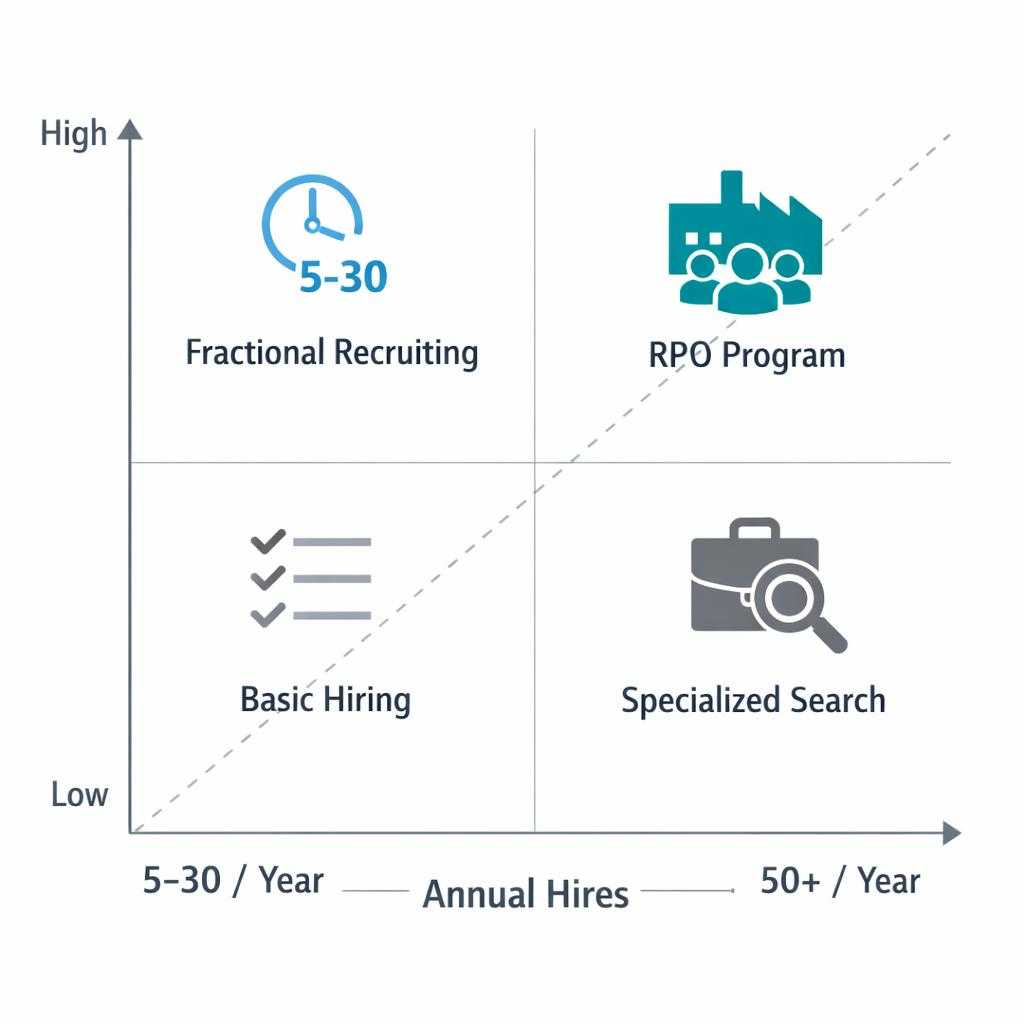
Most guides agree on the same breakpoint. RPO economics improve when you’re filling 10+ roles concurrently, often aligning with 50+ hires per year.
Annual hires matter, but concurrency is what makes the economics real. RPO earns its keep when you can keep a lot of requisitions open at the same time for long stretches because the weekly KPI reviews and approval workflows stay highly utilized. As waves of hiring extend, that’s when 50+ hires per year starts to pencil out.
Fractional tends to fit when you’re in the 5–30 hires per year range or your hiring is lumpy across quarters, because you’re buying recruiter output without paying for a full engine between bursts. Complexity pushes you toward more embedded help too, but not always toward RPO. Case in point: a 120-person construction contractor hiring a project manager, a superintendent, and three foremen over six months needs tight intake and disciplined scheduling, but they don’t need a multi-seat delivery team if only one to three reqs run at a time.
The trap is thinking “we plan to hire this year” equals “we have steady volume.” Ask yourself: how many roles will you have live at once for the next 90 days, and how often will that be true?
MSPs tend to feel the pain of lumpy hiring most when field-tech demand spikes unexpectedly, making fast ramp-up capacity more valuable than long commitments. Read more in our article: Fractional Recruiting Msps
Your Decision Shortlist: Fractional, RPO, Or Both
Choose the wrong model and the penalty isn’t just cost. It’s quarters of missed hires or months of paying for capacity you can’t use.
Choose fractional if you’re in the 5–30 hires/year range, your reqs come in waves, and you value month-to-month recruiting services more than a formal program. The minimum you need internally is a real hiring owner: someone who can run intake in 30 minutes, keep hiring managers on deadlines, and make fast yes/no calls so the part-time capacity doesn’t stall.
Choose RPO if you can keep high concurrency for long stretches (often 10+ reqs live, trending toward 50+ hires/year) and you’re willing to commit to governance. That means you assign an internal counterpart who can enforce process, approve tooling access (ATS/HRIS), and manage an RPO provider like an operator, not like an agency.
Use both when one part of your hiring is steady and high-volume, and another slice is specialized or intermittent (for example, RPO for recurring field roles while fractional covers a senior estimator or ops leader search). If you’re choosing RPO to “reduce internal work,” you’re about to pay for a program and still spend time quarterbacking it.
FAQ
Is Fractional Recruiting An RPO?
No. Fractional recruiting is typically part-time recruiter capacity with light integration and an easy off-ramp, while RPO is a program model that usually includes governance, reporting, and deeper integration into your ATS and processes.
What’s The Minimum Size For RPO To Make Sense?
In practice, RPO starts to make sense when you can sustain high utilization, often 10+ requisitions open at once for long stretches, which commonly correlates with 50+ hires per year. With stop-start hiring, the risk is paying minimums during months when utilization drops.
Can I Combine Fractional And RPO?
Yes. You can use RPO for steady, repeatable hiring (like ongoing field roles) and fractional for intermittent or specialized searches where you want flexibility or tighter operator-level involvement.
What Happens To An RPO Contract If My Hiring Slows?
Usually, you still pay the minimums or monthly fees you signed up for, and flexing down can require renegotiation or trigger penalties depending on the contract. That’s why you should model a 60–90 day slowdown before you commit, not after.
Related reading: Fractional Recruiting vs Contingency · Fractional Recruiting Cost in 2026 · How to Choose a Fractional Recruiting Partner
If you’re between fractional and RPO and want a 20-minute walkthrough of which one fits your actual hiring plan, schedule a call with Discovered. We’ll tell you straight, even if the answer is RPO.