
Tech staffing agencies mostly sell contract hours. Hours fit a seat that ends.
So before you call one, ask if the seat you need filled will end. At a managed service provider (MSP), most seats won’t. The tech you hire will hold admin credentials to client systems, learn each client’s quirks, and become the name the client asks for. That seat belongs on your payroll from day one. The sections below sort the seats an agency fills well from the ones it doesn’t, and price the difference.
What a Tech Staffing Agency Sells
A tech staffing agency’s core product is time. It keeps a bench of technicians and engineers, places them at your desk, and bills you an hourly rate that covers their pay plus the agency’s margin. Most agencies sell three arrangements.
- Contract staffing: You buy hours for a set role and timeframe, and the agency stays the employer.
- Contract to hire: The same arrangement, with the option to move the person onto your payroll later, usually after a conversion fee or a waiting period.
- Direct placement: You pay a one-time fee when a permanent hire starts, typically 20 to 30 percent of first-year salary.
Our guide to IT staffing agencies prices each arrangement and lists the questions to ask before you sign. The sections here cover the step before that one. Decide what kind of seat you’re filling first.
The Seats a Staffing Agency Fills Well
A new co-managed client signs, and onboarding will bury your service desk for three months. You call an agency, two contract L2 techs start the following week, and when the surge passes the hours stop. Nothing is left half-done, because the work itself had an end date.
Contract staffing does that job well. The hourly markup is the price of not carrying a salary after the work ends, and for a seat with a finish line it’s a fair trade. The seats that fit:
- A project with a real end date, such as a large migration, a hardware refresh across many sites, or a one-time firewall rollout.
- Cover for a tech on leave, where the work has to continue but your headcount plan doesn’t change.
- A specialist skill you need for weeks rather than years, like a short burst of scripting and automation.
- A spike in tickets while you run a separate search for the permanent hire.
In each case you know when the seat goes away. That’s the test.
Why Permanent MSP Seats Don’t Belong on Contract
A permanent seat at an MSP is more than a pair of hands on the ticket queue. The tech in it learns your clients’ tenants, firewalls and line-of-business apps, and that knowledge makes the second year cheaper than the first. Filling the seat with contract hours means paying an agency’s margin to rent knowledge you’re trying to keep.
Four things go wrong when a permanent seat runs on contract.
- Knowledge walks out the door. A contractor holds admin credentials to client systems. When the contract ends you revoke the credentials, but what the contractor learned leaves with them.
- Clients lose their tech. Clients get used to a name. Then the agency reassigns that person, or the contract ends, right when the relationship starts paying off.
- Loyalty stays with the agency. The contractor’s paycheck, benefits and next assignment all come from the agency, so your MSP is one client among several.
- Contract to hire narrows the pool. It only reaches candidates willing to take a contract, and the good ones still come with a conversion fee or a waiting period.
Agencies often sell contract to hire as a way to test fit. It tests fit slowly, at a markup. The fit test belongs in the hiring process, before the offer, where you check integrity, then attitude, then cognitive ability, and personality last. Markups and conversion terms vary widely by agency and market, so get every number in writing before anyone starts.
Sort the Seat Before You Call Anyone
Call an agency before you’ve named the seat, and you’ll hear a pitch for whatever the agency sells. Every vendor works that way. Run these five questions on your next open role first.
- Will this seat exist in 12 months?
- Will this person talk to clients as your tech?
- Will they hold admin credentials to client systems?
- Are you hiring more than one technical person this year?
- Does anyone inside have time to run the search?
A yes to any of the first three means a permanent seat. The last two decide how you fill it. The table maps the common situations.
| Seat Situation | What Fits | Why |
|---|---|---|
| Project with an end date | Contract staffing through an agency | You buy hours for a finish line and carry no salary afterward. |
| Leave cover | Contract staffing through an agency | The work continues for a set window, and your headcount plan stays the same. |
| One senior or hard-to-find permanent seat | Contingency or retained search | One hard search, where a recruiter’s reach on a single role earns the fee. |
| Two to five permanent technical hires a year | A flat monthly recruiting fee | The need never stops, so paying per hire is the most expensive way to cover it. |
| An executive seat | Retained search | A leadership hire needs a dedicated, structured search. |
Fractional recruiting, the fourth row, means an outside recruiter works as your recruiting department for one flat monthly fee and covers every open role. For the last row, see how executive search runs. If you’re comparing firms for the permanent seats, a two-week test will tell you more than any website.
What Three Permanent Seats Cost
Say you need three permanent technicians in the next six months, each at a $120,000 salary. Direct placement at 20 percent is $24,000 per hire, or $72,000 for all three. At 30 percent it’s $108,000.
Six months of fractional recruiting at $1,500 a month is $9,000, and it covers every open role in that window. A quality hire typically takes 4 to 12 weeks, so three hires in six months is realistic, though not guaranteed.
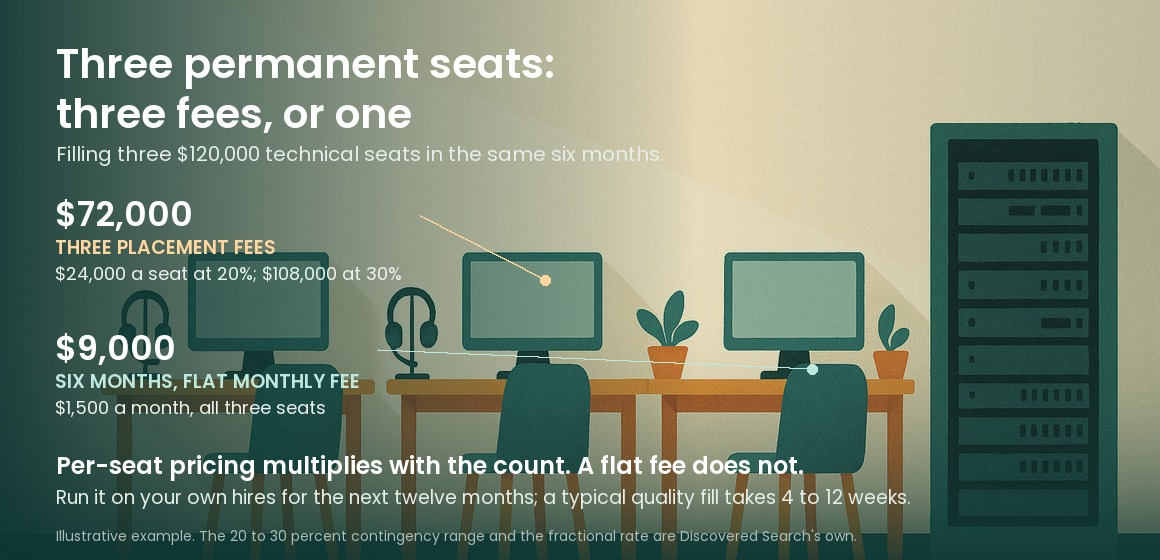
Run the same numbers on your own count and salaries. Even at one hire, a few months of the flat fee costs less than one placement fee, and the gap grows with every seat you add.
Permanent seats often land with an agency for a simple reason. Nobody inside has time to recruit, so the office manager or an HR generalist calls whoever the company used last time. As Fletcher Wimbush puts it, “HR people are not recruiters. Making a compliance admin focused HR person do recruiting is like making an accountant do sales.” Every fractional engagement carries a 30-day money-back guarantee, so the first month is the trial.
Frequently asked questions
Is Contract-to-Hire a Good Way to Test a Tech?
It works, but it’s a slow and expensive way to learn what a structured interview can show before the offer. It limits you to candidates willing to take a contract, and it still adds a conversion fee or a waiting period on the ones you want to keep.
What Do Tech Staffing Agencies Charge?
Agencies bill contract staffing by the hour, and the rate covers the tech’s pay plus the agency’s margin, which varies by role and market. Direct placement typically runs 20 to 30 percent of first-year salary, so a $120,000 hire at 20 percent costs $24,000. Get every fee, conversion term and replacement guarantee in writing.
Can You Use an Agency for Contract Help and Fractional Recruiting for Permanent Hires?
Yes, and it’s often the right split. Contract staffing covers the seat that ends, and a flat monthly fee covers the permanent seats. Decide up front which seats are temporary, so contract hours don’t become your default way to hire.
How Fast Can a Staffing Agency Fill a Seat Versus a Permanent Search?
An agency with a contractor on the bench can fill a short assignment quickly. A quality permanent hire typically takes 4 to 12 weeks, whoever runs the search. Plan around that timeline instead of hoping contract to hire will shorten it.
Will a Staffing Agency Find Your Long-Term MSP Tech?
Only if you’re buying a direct placement. Contract hours don’t turn into a long-term employee on their own. If the person will hold client relationships and admin access for years, hire them onto your payroll through a process built for permanent hires.
If fractional looks right on paper and you want to test it against your own hiring plan, schedule a 30-minute call with Discovered and we’ll run the numbers with you.