Your Tier 3 posting has been open five weeks. The inbox is full, and nobody has read past the first forty applications.
Inside a 10 to 100 person MSP, IT recruitment is a calendar problem before it is a sourcing problem. Long before a fee arrives, the owner and the service manager have already spent their week reading applications and running screens, on top of running service delivery. This article covers where those hours go, why operators end up doing it, and what you can do about it.
Where the Hours Go in IT Talent Acquisition
You blink and it’s Thursday again, and recruiting still hasn’t moved. The queue keeps growing, and the role stays open because the next step never makes it onto anyone’s calendar.
IT recruitment doesn’t start with interviews. It starts with a pile. Your Tier 2 or Tier 3 posting goes live, Indeed and LinkedIn do what they do, and you wake up to volume. Volume is rarely the constraint. Somebody still has to turn a noisy inbox into a short list, and do it before the two or three people worth hiring take another offer.
Most MSPs still describe recruiting as one task. Post the role, talk to a few people, hire. That description falls apart the first time you’re staring at a thousand applications and reading them has become a recurring meeting on your calendar. MSP owners give us the same count on sales calls. One technical hire runs 1,000-plus application reviews and 20-plus interviews before anyone signs anything.
That load spreads across six separate jobs, and each one costs you something different when it stalls.
| The Job | Who Does It in House | What It Costs You When It Slips |
|---|---|---|
| Write and place the posting | Owner, service manager, or ops lead | You attract the wrong applicants, then you pay for it in review time. |
| Review applications | Owner, service manager, or admin support | The queue grows, response time stretches, and the strongest candidates disengage. |
| Phone screens | Hiring manager or senior tech | Your best technical people lose blocks of focus, and you still don’t get to a short list fast. |
| Interviews and scorecards | Owner plus one to three technical interviewers | You burn several calendars at once and push the decision into next week. |
| Scheduling and follow-up | Dispatcher or service coordinator | No-shows rise, candidates assume you aren’t serious, and the role stays open. |
| References and offer | Owner or ops | Delays invite counteroffers, second thoughts, and last-minute renegotiations. |
Posting the job is the smallest part. The two rows in the middle, reviewing applications and running screens, are where your week goes.
Why IT Recruitment Falls on Operators
In a 10 to 100 person MSP, IT recruitment doesn’t fall to HR. It falls to whoever can answer two questions fast. Can this person do the work, and will they fit the way you deliver service? That’s usually the owner, the service manager, or the senior tech who feels it first when a bad hire turns into escalations.
The reason is boring. The people who run dispatch and jump on priority incidents are also the only ones you trust to judge real-world competence, so recruiting defaults to them. When a thousand applications hit the inbox, they own the outcome, so they own the reading. You tell yourself you’ll get to it after the P1 tickets, and then the queue grows and the role stays open another week.
An admin-leaning HR generalist doesn’t solve it either. As Fletcher Wimbush puts it, “HR people are not recruiters. Making a compliance admin focused HR person do recruiting is like making an accountant do sales.” A generalist can keep the process moving. Judging whether a candidate can hold a Tier 2 queue still pulls a technical person back in. That split is deliberate in our own candidate screening process.
The volume makes it worse, not better. An MSP hiring two to five technical people a year can’t justify a full-time recruiter, so nobody owns the work, and it never gets good. You relearn the same process three times a year with different people running it.
The displacement is immediate. You block two hours on Friday for phone screens, a client calls about a P1 outage, and the screens slide to next week. That slip costs more than time. It costs response speed, and speed is what keeps a good candidate in your process long enough to say yes.
Price Your Own Hiring Hours
A service manager gives up two afternoons to screens. A senior tech takes interviews between escalations. Nobody logs the time, because hiring isn’t a line item. Then you compare an outside fee to zero and decide the outside fee is expensive.
If you treat in-house recruiting as free, you’re pricing it against zero, and that isn’t how the rest of your business works. Every resume you skim comes out of the same week you use to sell, manage delivery, and keep clients from churning.
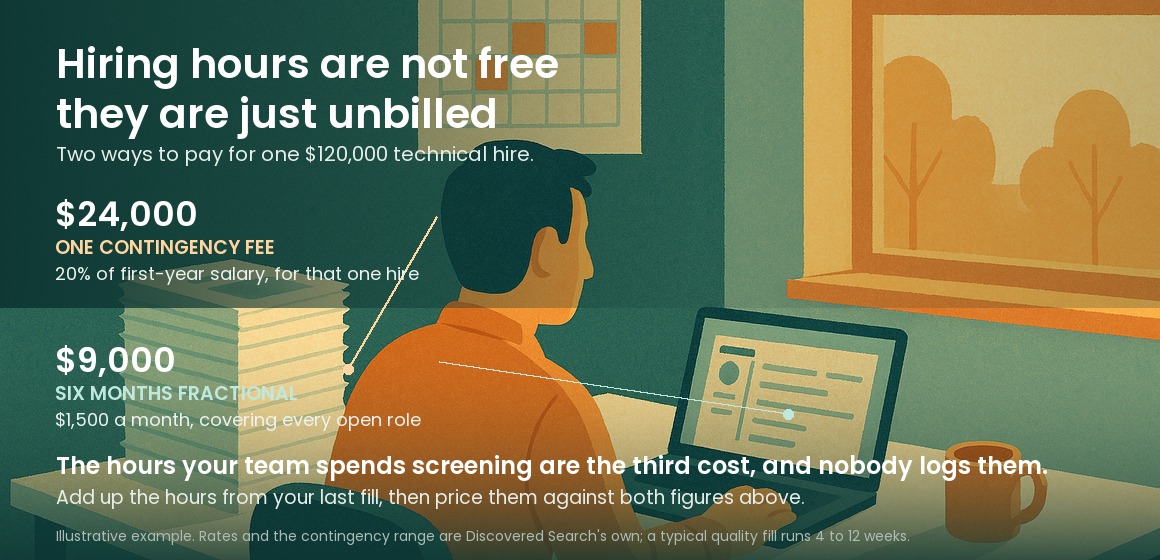
Run the number on your last hire instead of guessing. Add up the hours you personally spent across the whole fill, which typically runs 4 to 12 weeks. Then add the time you pulled from a service manager and a senior tech.
Multiply each person’s hours by what that time is worth in your company. Use the billable work you could have delivered, the margin on work you could have sold, or the value of leadership time that keeps escalations down. The figure is yours, not an industry average, and that’s the point.
Then check it against the two outside prices you can compare it to. Contingency recruiting runs 20 to 30 percent of first-year salary, so a $120,000 hire at 20 percent is $24,000. Fractional recruiting runs $1,500 a month on a six-month commitment, or $2,500 month to month, with a 30-day money-back guarantee.
The full fee breakdown is in our piece on what an IT recruiter costs. Most owners who run their own number are surprised by how much of their week the free option was using.
The First Failure Point Is Speed
Good technical people rarely disappear because nobody found them. They disappear because the process went quiet on them.
The gap between application, first response, and first screen decides who’s still engaged when you’re ready to talk. A solid Tier 2 candidate is usually in three processes at once. Reply next Friday and you aren’t being selective, you’re late, and the candidate has already read that as how you run a service desk.
In-house recruiting stalls right here. You batch recruiting around client work, so every step waits for the next open block. You plan to clear the inbox after the Monday service meeting, a P1 hits, and resume review moves to Wednesday. By the time you schedule screens you’re negotiating your calendar, a senior tech’s calendar, and the candidate’s.
Two questions tell you where you stand. What is your response-time target for a technical applicant, and how many days can a candidate wait between steps before you see drop-off? If you can’t answer either one, you’re running IT recruitment on inbox timestamps.
Three Ways to Buy Back the Hours
Once you accept that recruiting is a weekly calendar load, you have three options. All three cost something. The real question is which week you want to protect.
Tighten it in house. Run recruiting like ticket flow. Give the queue one owner and set a same-day or next-day response target for technical applicants. If your service manager always loses Friday screens to escalations, move screens to Tuesday. Hand scheduling and follow-up to someone else so the process doesn’t stall when delivery gets loud.
Pay contingency per hire. Contingency offloads sourcing and some coordination when you’re underwater, and you pay only on a placement. The incentive is structural, though. A contingency recruiter earns on a closed placement, which rewards speed to an offer more than care in screening. You still need fast feedback and fast decisions on your side. Our comparison of fractional recruiting and contingency walks through where each model holds up.
Run fractional. Fractional recruiting is a flat monthly model built for companies hiring two to five technical people a year that can’t justify a full-time recruiter. You’re buying consistent ownership of the inbox, the screens, and the follow-ups.
It runs $1,500 a month on a six-month commitment, or $2,500 month to month. If you’re already losing candidates between steps, what you get back is response speed. The model is covered in more detail in our piece on the fractional IT recruiter.
Frequently asked questions
What Does IT Recruitment Include for an MSP?
It’s the whole pipeline from posting through offer. That means writing and placing the ad, reviewing applications, phone screens, technical interviews, scheduling, references, and the offer itself. Count only the interviews and you miss the work that eats the week.
How Fast Do You Need to Respond to Candidates?
Fast enough that the process never goes quiet between steps. If your next touchpoint routinely waits for Friday afternoon, you’ll lose solid Tier 2 and Tier 3 candidates to whoever answered them first.
Does Fractional Recruiting Replace My Hiring Manager or Technical Interviewers?
No. Fractional recruiting takes daily ownership of the inbox, the follow-ups, and the pacing. You still own the technical evaluation and the final yes or no.
When Does Contingency Recruiting Make Sense?
It works when you want a per-hire option. The fee is 20 to 30 percent of first-year salary, so a $120,000 role at 20 percent costs $24,000. Keep in mind that the recruiter earns on the close, so the pressure runs toward an offer rather than toward careful screening.
How Do I Compare In-House Time to Outside Help Without Inventing an Hourly Rate?
Use your own number. Ask what you would have done with those hours if you weren’t recruiting. Price that in billable work, sold work, or avoided delivery risk over a 4 to 12 week fill. Then set the result beside a contingency fee and a monthly fractional fee and see which one you’d rather pay.
If fractional looks right on paper and you want to test it against your own hiring plan, schedule a 30-minute call with Discovered and we’ll run the numbers with you.