
SAP staffing is two purchases wearing one name. One of them ends. The other should not.
Most firms sell both off the same rate card, so the difference disappears at the quoting stage. A company books a consultant for a cutover, renews the work order twice, and winds up funding a full-time salary without ever making a hire. Below is how to tell the two apart before you sign, and what each one costs.
The Two Purchases Behind the Phrase
The first purchase is capacity for a window. You have a go-live, an upgrade or an S/4HANA migration, you need hands that know the modules, and the work has a finish line. A staffing firm bills you hourly for a named consultant until the work order closes. That trade is clean when the end date is real.
The second purchase is an owner. Someone has to hold configuration decisions, security roles and master data after the project team leaves. That person answers the Monday morning ticket about a role change nobody wrote down. Buying that seat by the hour gives you access to the system and no memory of it.
That permanent seat goes by several names. ERP or SAP analyst, basis administrator, security-role owner, integration owner, finance systems analyst. Titles vary by company and the job underneath them rarely does. Somebody holds the configuration, somebody approves the role changes, and somebody answers the phone when a transport breaks something downstream.
Buyers confuse the two because both start with a search for an SAP resume. They finish differently. One finishes when the project does. The other should still be on your payroll in three years.
Why the Permanent Seat Keeps Getting Re-Rented
Nobody on the payroll owns the system, so every change becomes a small project. New users arrive. An integration changes. A role request touches segregation of duties. Each one needs somebody who knows what the last consultant built and why, and that somebody rolled off months ago.
So you book another contractor. The new one spends the opening weeks of the engagement learning what the previous one already knew, and you pay for that re-onboarding every cycle. A managed service provider (MSP) that took over a client’s SAP environment after go-live meets this first. The service desk can triage a ticket. It can’t answer why the configuration looks the way it does.
Three signs the rental turned into a permanent seat a while back:
- The same access and role-change request comes back every few weeks.
- Every small change needs a meeting with a staffing firm before any work starts.
- Nobody can say who owns a configuration decision and who only executes it.
All three at once mean the work stopped being a project a while ago.
What an Hourly Bill Rate Buys
A bill rate buys a named consultant for a defined stretch of time, priced above what that consultant takes home. The spread covers the firm’s sourcing, payroll and risk. For a cutover with a hard date, that’s a reasonable thing to buy, and buying it fast matters more than buying it cheap.
What the rate doesn’t buy is anything after the work order closes. Documentation habits, decision history and judgment about your environment leave with the consultant unless an employee was there to absorb them. Renewing the engagement until things settle down turns a window into a rental with no end date.
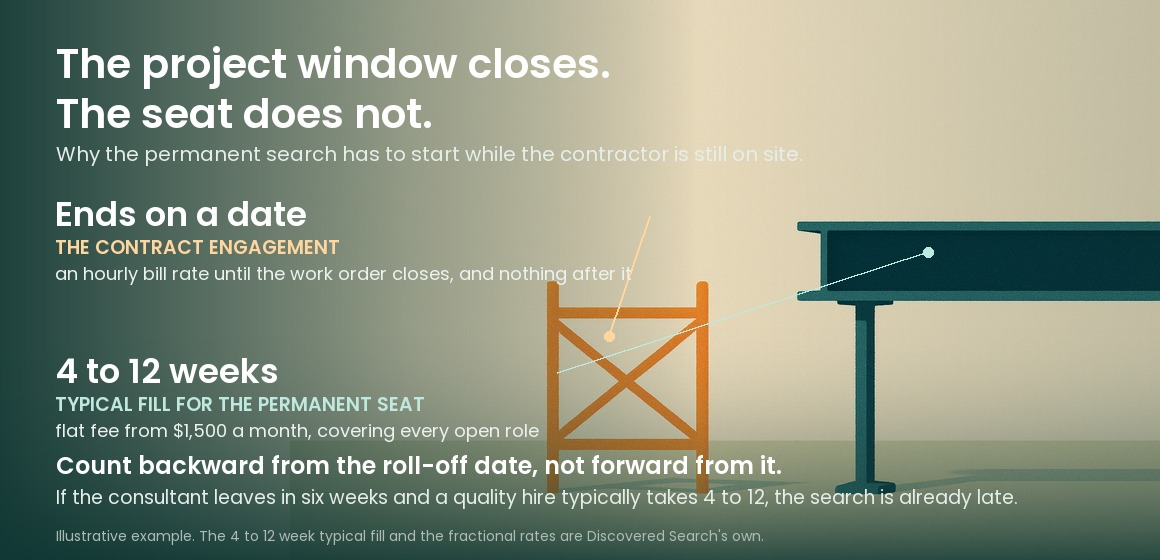
The practical rule is to count backward from the roll-off date. A quality hire typically takes 4 to 12 weeks, so a search that opens the week your consultant leaves has opened six weeks late. Start it while the engagement still has runway, and the handover has somebody to receive it.
Firms that sell both models will quote the hourly one first, because it closes faster. Knowing that about IT staffing agencies is reason enough to ask for the second quote as well.
Three Ways to Buy, and When Each One Fits
Line the three models up against the work you want to own, and the choice gets easier.
| How you buy it | What you pay | What it covers | When it is the right tool |
|---|---|---|---|
| Contract staffing | An hourly bill rate for the length of the engagement | One named person on one project | You have a defined implementation window with an end date |
| Contingency search | 20 to 30 percent of first-year salary. A $120,000 role at 20 percent is $24,000 | One hire | You need a single senior seat filled and you won’t hire again this year |
| Fractional recruiting | $1,500 a month on a six-month commitment, or $2,500 month to month, with a 30-day money-back guarantee | Every open role | You have two or three hires a quarter and nobody whose job is hiring |
The models separate on coverage. A contingency fee pays for one seat and stops there. A flat monthly fee covers every role open during the engagement, which matters when the SAP seat is one of three you need this quarter. The difference between fractional recruiting and contingency is worth reading before you sign either one.
How to Screen for an SAP Seat You Can’t Read
If you’re not in the modules daily, every SAP resume looks the same. S/4HANA, a list of modules, a certification or two. Screen on that list alone and you’ll hire someone who talks configuration well and shouldn’t go near master data.
The FACT Driven Hiring System puts the skill check where it belongs. Framework comes first. Write the seat the way it runs day to day, because an SAP analyst at an MSP usually owns security-role requests and master data changes rather than greenfield process design.
Attraction follows the framework. Outreach that describes a greenfield build will attract project consultants, and they leave the moment the work turns into ownership.
Ask for Stories Instead of Module Lists
Candidate evaluation runs in a fixed order. Integrity comes first, then attitude, then cognitive ability, then personality, which predicts the least. Ask questions that force a story instead of a recitation. What broke in the last cutover you supported, and who did you call first? Tell me about a master data change that caused damage downstream, and what you changed so it wouldn’t repeat.
Listen for cause and effect, and for the habit of writing decisions down so the next ticket doesn’t depend on one person’s memory. Our screening process runs that way for every technical seat.
Training closes the rest. No SAP hire matches every module and every client variant, so plan the ramp before the offer goes out and budget shadowing time for the gaps.
When Discovered Is the Wrong Call
Three situations where the fractional model costs you money instead of saving it.
You need one consultant for a fourteen-week implementation and nothing after it. Use a staffing firm. That’s a capacity purchase, and Discovered doesn’t sell capacity by the hour.
You’re hiring a head of enterprise applications or a CIO. That calls for retained executive search, a different process on a different fee.
You make one technical hire a year and somebody internal already recruits well. A single contingency fee may cost you less than six months of anything else.
What’s left is the case the flat fee fits. Two or three hires a quarter, nobody whose full-time job is hiring, and a permanent SAP seat among them.
Frequently asked questions
Should You Hire a Contractor or an Employee for a Go-Live?
Usually both. Buy the contractor for the cutover window, and start the permanent search at the same time. A quality hire typically takes 4 to 12 weeks, so a search that starts when the consultant rolls off has already started late.
What Does It Cost to Fill an SAP Analyst Seat?
That depends on the model. Contingency search runs 20 to 30 percent of first-year salary, so a $120,000 role at 20 percent is $24,000. Fractional recruiting is $1,500 a month on a six-month commitment, or $2,500 month to month, and it covers every role you have open.
How Long Does a Permanent SAP Hire Take?
Four to twelve weeks is typical for a quality hire, and the harder seats take the full twelve. Keeping a contractor on indefinitely feels faster, though mostly it postpones the search.
Do You Need Deep SAP Experience, or Can You Train It?
You need enough to do the job from week one. Past that, module depth predicts less than integrity and attitude do, and the remaining gaps close with runbooks and shadowing.
What Happens If the Hire Doesn’t Work Out?
Every fractional engagement carries a 30-day money-back guarantee on the engagement itself. That covers our service rather than warranting any individual, so your evaluation process still has to be good.
If fractional looks right on paper and you want to test it against your own hiring plan, schedule a 30-minute call with Discovered and we’ll run the numbers with you.