You’re searching “engineering staffing firm” because you need hiring help now. That one phrase covers three different purchases. If you pick contract staffing for a permanent seat, you’ll pay for motion instead of progress.
The three are contract hours with an end date, one contingency placement paid on the close, and the hiring function itself on a flat monthly fee. Most 10 to 100 person engineering businesses aren’t trying to rent Civil 3D production hours. You’re trying to fill a permanent seat with real constraints, and that’s a search, not an order placed against someone’s inventory.
Three Things Sold Under One Name
An ops lead asks three firms for engineering staffing help and gets three quotes that aren’t the same product. Two weeks later the argument is about price, when the mismatch is what each firm gets paid to do.
Shopping the three as interchangeable is how you end up with rework and spent project manager hours. You’re not buying a civil PE or a senior project manager. You’re buying a pricing model, and the incentives come with it. Name the purchase first and the right vendor type is obvious.
Hours, One Placement, or the Function
Engineering contract staffing is hours with an end date. You pay an hourly rate above the engineer’s own, for as long as the engagement runs. That’s the right instrument when the need is project shaped, say eight weeks of extra Civil 3D production to clear a subdivision submittal set. If that’s your situation, hire the hours, and none of what follows applies to you.
Contingency placement is one seat, paid on the close. You pay 20 to 30 percent of first-year salary when you hire, so $24,000 on a $120,000 role at 20 percent. It can work. It also pays the recruiter for the close, and nothing in that model pays for building your process or for what next year’s hiring looks like.
Fractional recruiting is the hiring function on a flat monthly fee. You pay a predictable monthly amount that covers sourcing and screening for every open role rather than one requisition.
If you’re juggling two project manager hires and a mid-level structural engineer while still running delivery, the monthly model is the one built to take sourcing and screening off your desk. It differs from an RPO contract mostly in pricing structure, process ownership and how fast you can start. We run that comparison in fractional recruiting versus RPO.
Availability Isn’t a Qualification
A staffing firm’s bench is whoever is free this week. That sounds useful until you look at what binds an engineering seat.
- The license the org chart needs, and the states it has to cover
- The project types the person has run end to end
- IBC, ASCE 7 and the local amendments in the jurisdictions you work in
- The software your team runs day to day
None of those track with being available. Say you need a civil PE to own stormwater calcs, coordinate with the municipality and produce in Civil 3D inside your templates. The person who can start Monday might be perfect. They might also be free because they’ve bounced between firms and never taken a set through plan check.
Treating availability as proof of competence costs you later in rework and project manager time. The only way to tell is the screening nobody wants to do, which means verifying license status and testing the project history claim by claim. Ask any firm for written screening notes tied to your constraints rather than a stack of resumes. We publish our own screening steps for that reason.
That screening usually falls to HR or a hiring manager who already has a full job. As Fletcher Wimbush puts it, “HR people are not recruiters. Making a compliance admin focused HR person do recruiting is like making an accountant do sales.”
Cost Lines: When the Paying Stops
You can stay busy while the spend keeps running. If you don’t know where the meter ends, you can’t compare options no matter how many resumes arrive.
So ask two questions of any quote, from a staffing firm, an engineering recruiter working on contingency, or a retained search. When does the meter stop, and what did you get while it ran?
| Model | What You Pay | When the Paying Stops | What It Covers |
|---|---|---|---|
| Contract staffing | An hourly rate billed above what the engineer is paid | When the engagement ends | The hours worked and nothing else |
| Contingency placement | 20 to 30 percent of first-year salary, so $24,000 on a $120,000 role at 20 percent | At the placement | One seat, one time |
| Fractional recruiting | $2,500 a month, or $1,500 a month on a six-month commitment | When you stop | Every open role, from sourcing through reference checks |
The table leaves out the part that decides a budget. The hours never stop costing, the placement stops at the placement, and the monthly fee stops when you stop. The mechanics of that last one, including what starts a billable month, are in how our monthly fee works.
Before you call anyone, split your open roles into two piles. One pile needs time-boxed capacity tied to a project end date. The other is a permanent seat you’ll still own next quarter. Without that split, you blame a vendor for a cost line you chose.
What the First Month Can and Can’t Tell You
Every fractional engagement here carries a 30-day money-back guarantee. That window is shorter than the thing it’s meant to reassure you about. A quality engineering fill typically takes 4 to 12 weeks, so the guarantee usually expires before anyone starts.
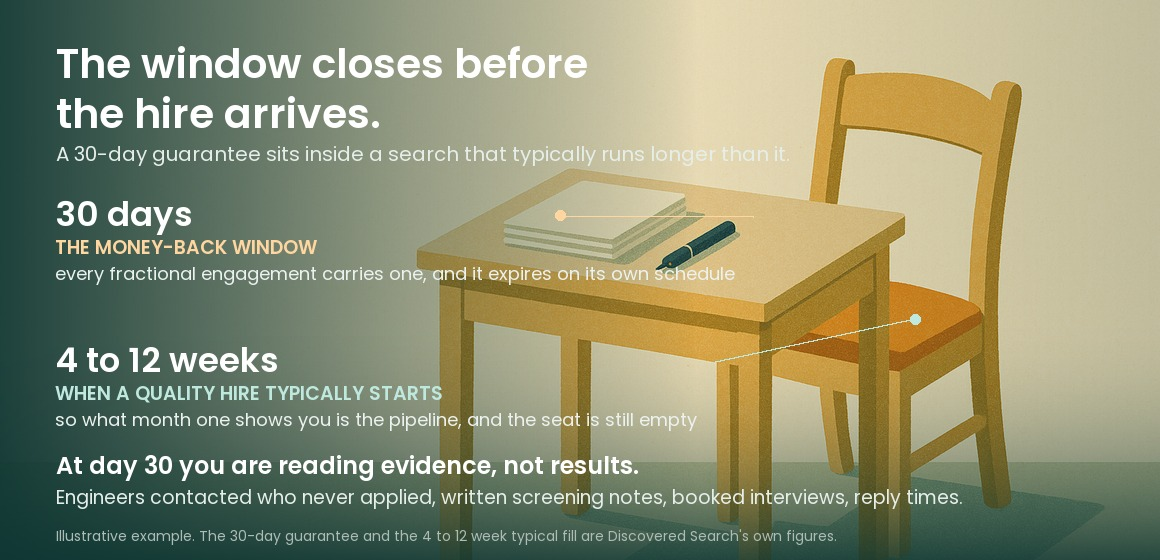
So judge month one on pipeline. Count the engineers somebody called who never applied, and read the screening notes for your own license and project-type constraints. Then look at the calendar for booked interviews, and time how long an interested candidate waits for a reply.
What you won’t have by day 30 is a hire. A firm promising a start date inside that window sells you the half of the market already looking. Decide before you sign what you’ll accept as evidence in month one, and say it out loud to whoever you hire.
Write the Seat Down First
No staffing firm can rescue a role you can’t write down. You’ll get motion, resumes and meetings, then you’ll stall because nobody can name the work the seat has to do. That’s how a mid-level engineer turns into three different jobs and a month of spent project manager time.
A typical fill runs 4 to 12 weeks, and the two weeks you spend arguing about the seat come out of the front of that.
Use the FACT Driven Hiring System to force the clarity before anyone sources.
Framework
Write the constraints that bind delivery. A civil PE who can stamp in Texas is a constraint. A strong communicator isn’t. Include the work you need them to own, like stormwater calcs and submittal sets. Name the tools you run, like Civil 3D templates and Revit families, and the capacity outcome you want by week six.
Attraction
Decide what you’re willing to have be true so the right person says yes. Spell out what you won’t flex on, usually license, project type and time in the office, and what you’ll flex on, usually title, start date and which projects they touch first. Keep “we’ll figure it out” in the pitch and you’ll attract candidates who are also figuring it out.
Candidate Evaluation
Run evaluation in order, integrity first, then attitude, then cognitive ability. Ask for specific examples with consequences, like a missed deadline they owned or a plan check comment they disagreed with. Personality is the least predictive of the four, so let it break ties.
Training
Define the first 30 days as a checklist. Name who reviews their first deliverable, what done means for a first sheet set or model update, and how fast you expect internal replies. That first review catches a CAD-only hire, because the work doesn’t lie.
Frequently asked questions
What Do You Buy When You Hire an Engineering Staffing Firm?
One of three things. Contract hours with an end date, one contingency placement paid when you hire, or the hiring function itself on a flat monthly fee. Name which one you want before you compare vendors, or you’ll compare them on resumes delivered and miss the incentives underneath.
When Does Contract Staffing Make Sense Versus a Permanent Hire?
Buy hours when the scope is project shaped and ends on a known date. If that need is still there next quarter and you’ll keep owning the seat, run it as a permanent search instead of renting hours.
Why Doesn’t a 30-Day Money-Back Window Tell You If Hiring Is Working?
A quality engineering hire typically takes 4 to 12 weeks, so a 30-day window usually closes before anyone starts. In month one you’re judging pipeline quality and speed of response. A start date is a month-three question.
What Should You Look for in the First Month If You’re Paying a Monthly Fee?
Look for engineers contacted who never applied, screening notes tied to your license and project-type constraints, interviews booked on the calendar, and reply times measured in hours. Together they tell you if the search is moving. Ask for them in writing at day 30, while the money-back window is still open.
How Do You Keep Hiring Costs Predictable Without Paying 20 to 30 Percent Placement Fees?
Pay for the function rather than the placement. A flat monthly fee covers sourcing and screening across every open role, and it stops when you stop the engagement. You still pay the salary once you hire, and you don’t stack a $24,000 fee on a $120,000 role to get the search done.
If fractional looks right on paper and you want to test it against your own hiring plan, schedule a 30-minute call with Discovered and we’ll run the numbers with you.