Hiring an information technology recruiter should buy you a seat defined well enough that screening gets fast and the offer goes to the right person. Writing the job posting is the cheap part. A recruiter who skips the definition work will send resumes from Indeed and ZipRecruiter until you stop asking.
Inside a managed service provider (MSP), IT is a department label rather than a skill. An L2 help desk seat and a Tier 3 service seat share a budget line and almost nothing else. What follows is what a good recruiter hands you in week one. Then the questions that prove they can do it, and the model that fits two to five hires a year.
IT Is a Department, Not a Skill
When a recruiter says they recruit IT, you still don’t know what they can fill. The seats inside that label share a cost center and little else. Hand one a generic req for an IT generalist and what comes back is keyword matching.
Two roles can both sound like technical support. An L2 help desk hire lives on ticket flow and escalation judgment. A Tier 3 service tech lives on root-cause thinking and change risk. A recruiter who can’t name that difference before reading your job description can’t help you write one.
The Seats Look Similar Until You Hire One
Titles lie in MSP hiring. A sysadmin title can mean steady-state patching and tooling ownership, or a project-heavy migration lead. A network engineer might own stability across client sites, or build new standard stacks. A cloud engineer might skew toward Azure permissions or toward Terraform delivery.
Service-side leadership splits even harder. A service manager owns queue health and dispatch. A vCIO owns client-facing planning and roadmap clarity. One screen won’t cover both.
What Changes from Search to Search
A recruiter who’s useful to an MSP changes the intake and the pass-fail bar by seat. One who doesn’t will run you through 20-plus interviews against a standard nobody wrote down, then call the miss a culture problem.
An L2 or L3 help desk search should pin down what a clean escalation looks like in your shop. A network or cloud search should pin down where the work happens, project delivery against reactive support. It should also settle if on-call is real.
Use a fast vetting bar. Ask a recruiter to name the first five things they need to know to tell your open seat apart from the one beside it. An answer of “send me the JD” means you’re buying a search engine at a human price.
Where Technical Hires Go Wrong
Most MSP technical hires go wrong at specification rather than at sourcing. Somebody writes down a wish list and calls it a job description. That one upstream mistake turns into 1,000-plus application reviews and 20-plus interviews per hire.
More inbound doesn’t fix it. More inbound makes it worse, because you screen faster against the same fuzzy Tier 3 scope. If you never settled what Tier 3 means in your shop, you’ll interview two different species of candidate. Outage ownership with real on-call and a project-heavy escalation tech with light after-hours are different jobs.
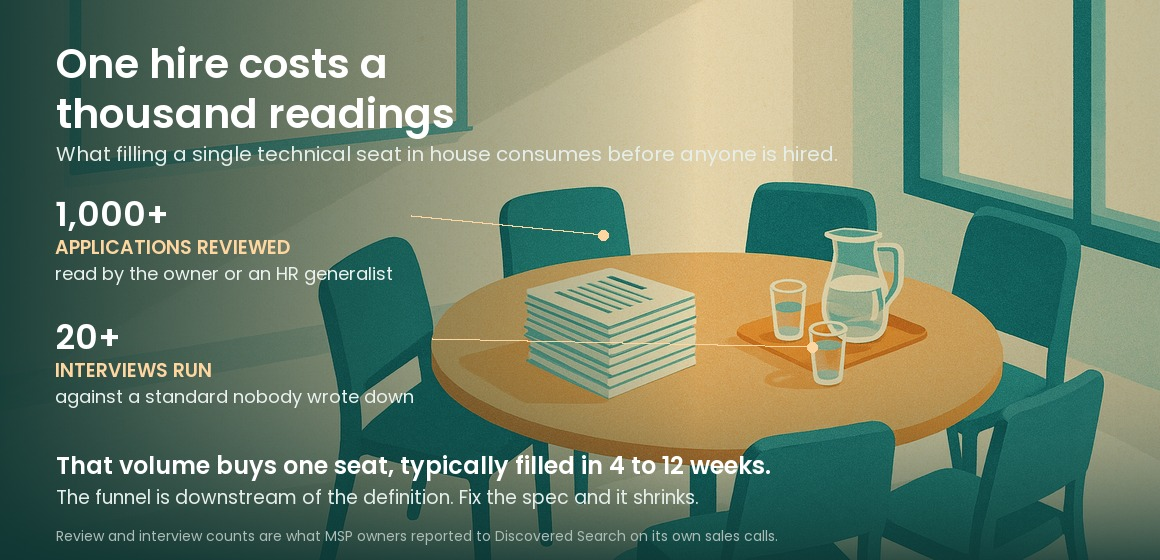
A recruiter who starts sourcing from your existing job description turns that document into a faster filter. The scorecard still doesn’t exist. You still spend a typical 4 to 12 weeks finding a quality hire, and calendar pressure now pushes you to settle before the seat is testable.
A fuzzy spec becomes visible once you watch time-to-fill, interview-to-offer ratio and 90-day retention. Those sit among the hiring metrics worth tracking. They show when your funnel does work your job description should have done.
What a Real Recruiter Does Week One
Skip the definition work and the bill arrives in leadership time. You argue over finalists on instinct, because nobody agreed on pass-fail outcomes while agreeing was still cheap.
Week one turns a “we need a senior tech” ask into a role you can measure. Skipping it doesn’t only make the search slower. It makes the search louder, with more resumes, more interviews and the same argument about why finalist A beats finalist B.
Five Outputs You Should Have in Writing
A one-page scorecard. Six to ten pass-fail outcomes for the first 90 days. An L3 escalation seat might include owning an outage bridge without wandering, and writing postmortems somebody else can use. Knowing Microsoft 365 isn’t an outcome.
Must-haves against trainables. What you pay for today, and what you teach in 60 days. If everything is a must-have, the req is vague rather than strict.
Level calibration. What senior means in your environment, tied to scope. Solo ownership of your hardest client and mentoring plus light project work are different candidates.
A constraints list. On-call reality, remote rules, client travel, comp band, start date, and anything that will kill an acceptance.
A screening plan. Who asks what, in what order, and what counts as a pass. Here’s where your HR generalist stops inventing screens between tickets.
Why the Scorecard Decides the Rest
A scorecard only works if it names the behaviors that separate a strong performer from a candidate who looks qualified on paper. What distinguishes a high performer is harder to write down than most reqs attempt. As Fletcher Wimbush puts it, “HR people are not recruiters. Making a compliance admin focused HR person do recruiting is like making an accountant do sales.”
How to Vet Information Technology Recruiters Fast
Vetting an information technology recruiter doesn’t take a long process. Listen to how they think before they touch your job description. A recruiter who starts with the document will sell you faster noise.
Four Questions for the First Call
“Talk me through how you’d tell this seat apart from the one next to it.” L3 escalation against Tier 3 project tech, or service manager against vCIO. A recruiter who can’t name differences in outcomes and pace will default to keyword matching.
“What do you need from me in week one, and what do I get back in writing?” Listen for a scorecard, must-haves, constraints and a screening plan. “Send the JD and the comp band” skips the part that prevents 20 interviews.
“What are your pass-fail signals for the first 90 days?” A good answer names behaviors such as ownership of an outage bridge, clean escalation notes and queue control. A weak answer lists tools.
“When would you tell me not to hire for this role as written?” Recruiters who can calibrate a level push back on senior scope at junior money, or on-call described as rare when it happens weekly.
Choosing a Recruiting Model by Hiring Volume
What you buy from an information technology recruiter is a fee structure, and the structure decides the behavior. Two to five permanent hires a year is a different purchase from contract hours next week. Tech staffing agencies are good at the second one and rarely the answer to the first.
Start with how predictable the cost has to be, then look at what the fee rewards. A percentage fee prices by salary rather than by difficulty. It can overcharge you for an easy-to-specify leadership seat and under-reward the grind of a hard mid-level service hire.
| How you buy it | What you pay | What the fee rewards | When it fits |
|---|---|---|---|
| Contingency | Typically 20 to 30 percent of first-year salary (a $120,000 role at 20 percent is $24,000 per hire) | Speed to placement and offer acceptance | When you can already specify the seat and will trade some depth for a fast start |
| Retained search | A percentage of first-year salary, paid against milestones | Priority and dedicated search time | When the role is senior, high-impact or confidential and one firm should own the process |
| Contract staffing | The spread between bill rate and pay rate, by the hour | Filled hours rather than long-term fit | When you want capacity for a project surge, coverage or a migration |
| Fractional on a flat monthly fee | Typically $1,500 a month on a six-month commitment, or $2,500 month to month | A steady process across every open role | When you hire a few times a year and need predictable spend and repeatable role definition |
Two disqualifiers save money. If you hire one person this year and can already specify the seat cleanly, you probably don’t need an external recruiter. If what you need is coverage for a rollout, don’t make permanent recruiting solve a staffing problem.
For an MSP hiring on a steady trickle, the comparison worth running is fractional against contingency. One contingency placement on a $120,000 role at 20 percent costs $24,000. Six months of fractional recruiting at $1,500 a month costs $9,000 and covers every open seat. That matches how MSP hiring usually arrives, a few roles a year rather than one big push.
Frequently Asked Questions
How Long Does It Typically Take to Fill an MSP Technical Role?
A typical quality permanent hire takes 4 to 12 weeks. Difficulty moves that range more than applicant volume does. If resumes flood in and the calendar still slips, the target is fuzzy rather than the inbound thin.
What Does a Contingency Fee Cost in Real Dollars?
Contingency commonly runs 20 to 30 percent of first-year salary, so a $120,000 hire at 20 percent costs $24,000. That math is easy to run. It doesn’t track difficulty, and some of your hardest seats won’t be your best paid ones.
When Does Hiring In-House Beat Using an External Recruiter?
In-house wins when you can specify the seat cleanly and somebody can run recruiting daily rather than between tickets. If your process is 1,000-plus application reviews and 20-plus interviews per hire, you already pay for in-house in leadership hours.
When Should You Choose Contract Staffing Instead of Recruiting?
Choose contract staffing when you want hours, such as surge coverage, a migration push or a finite project. A seat that carries admin credentials to client environments and takes an on-call rotation belongs on your payroll from day one.
What Should You Budget for a Fractional Recruiter?
A flat monthly fee typically runs $1,500 a month on a six-month commitment, or $2,500 month to month. Ad spend on a search is usually zero and tops out around $300 a month per role. Discovered backs every fractional engagement with a 30-day money-back guarantee.
If fractional looks right on paper and you want to test it against your own hiring plan, schedule a 30-minute call with Discovered and we’ll run the numbers with you.