Most fractional recruiters sound identical until you’re two weeks in and still staring at unqualified Indeed applicants. You want time back, and a résumé-forwarder is just another time drain. As Fletcher Wimbush puts it, “HR people are not recruiters. Making a compliance admin focused HR person do recruiting is like making an accountant do sales.”
If you’ve already decided the fractional recruiting model makes sense and you’re comparing 2–4 providers, skip more pitch decks. Ask questions that force specifics about screening, sourcing passive candidates, and how the engagement actually runs. The seven questions below will help you separate an embedded partner with a real methodology from a contingency-style operator with a new label.
The 7 Questions to Choose a Fractional Recruiting Partner
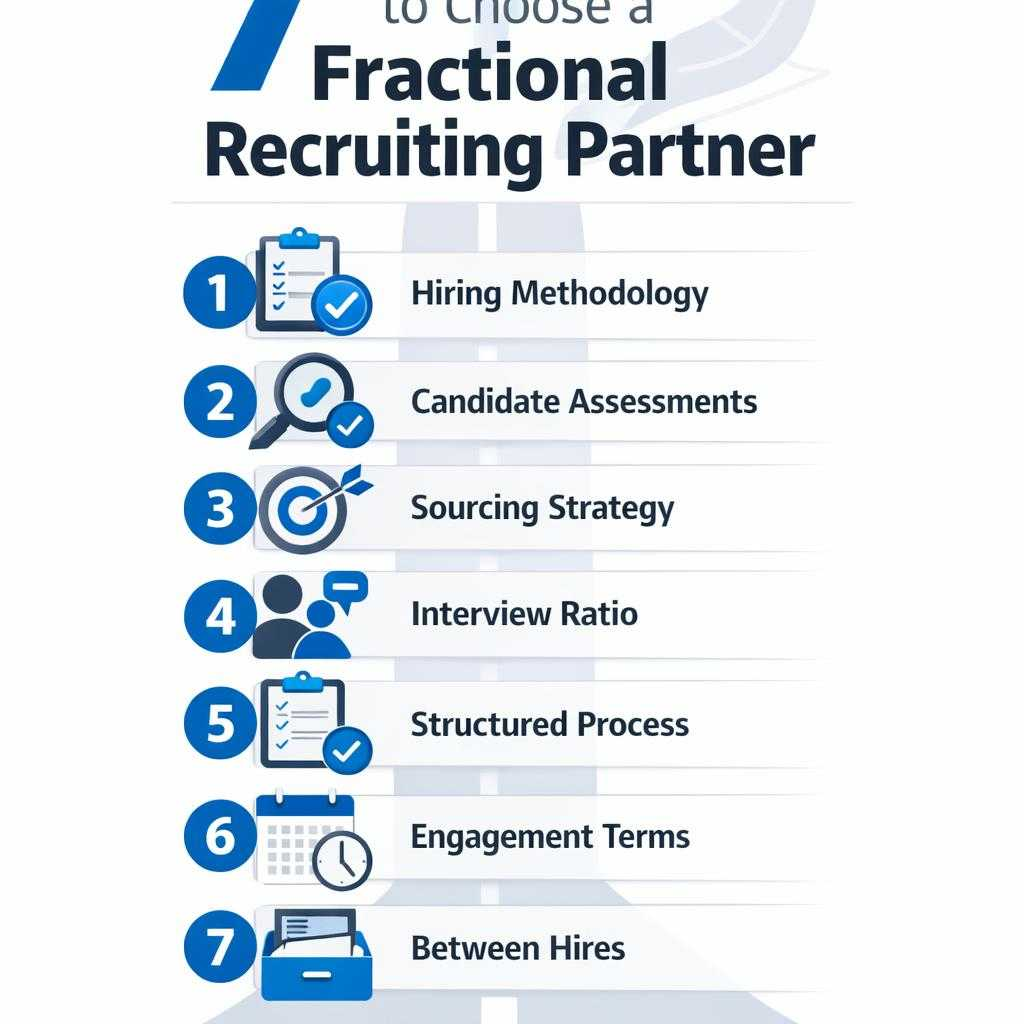
What Hiring Methodology Do You Use, and What’s It Based On?
A repeatable hiring system has to replace instinct-based screening. Otherwise you’re renaming it.
A provider who can’t name their method or its origin is selling personal instincts dressed up as a process. That usually means inconsistent screening and inconsistent slates. Case in point: in an MSP, a recruiter who screens on vibe will over-index on “culture fit” and miss the hard realities of ticket throughput and after-hours rotation.
Examples of strong answers:
-
A named, teachable system (Topgrading, Lou Adler-style performance-based hiring, Kingsley Wimbush, or a clearly derived hybrid), plus how it shows up in intake, screening, and the shortlist.
-
Clear artifacts: scorecards and pass-fail criteria.
-
A view on incentive alignment, especially if you’re comparing against agency models (see Fractional Recruiting vs Contingency Recruiting).
Examples of weak answers:
-
“We have a process,” but they can’t point to named methods, artifacts, or what changes role to role.
-
A résumé-first pitch that treats recruiting like keyword matching plus scheduling.
-
A promise that they can fill anything because they’ve “been doing this for 20 years.” Experience matters less than whether the method produces repeatable signal.
What Assessments Do You Use, and What Do They Predict?
Many teams say they want “foremen and service coordinators who show up and hit SLAs,” then rely on unstructured interviews to guess at integrity and coachability. You can’t. If the provider leans on personality profiles as the main screen, you’ll get confident talkers, not consistently dependable performers, especially in roles where reliability beats charisma.
Examples of strong answers:
-
Integrity, cognitive ability, and attitude or work-ethic style assessments, with a plain-English explanation of what each predicts on the job.
-
A stance on validity: they can explain why the tool correlates with performance and where it does not.
-
A workflow: when the assessment happens (usually before final interviews) and how it informs debriefs.
Examples of weak answers:
-
“We use DISC” or “we do personality tests” as the center of the funnel.
-
Vague claims like “our assessment finds A-players” without defining what “predictive” means.
-
No guardrails, which turns the assessment into either theater or an excuse to reject people without evidence.
How Do You Source Passive Candidates?
Without a real outbound engine, fractional help can still leave you triaging inbound applicants late at night.
Ask this directly or the engagement can slide into job posting and applicant review, which is the exact work you’re trying to offload. In a tight local market, your best fit might be employed and not applying anywhere, like a project manager at a regional GC who would move for a cleaner schedule and a better superintendent relationship.
Examples of strong answers:
-
A documented outbound motion: LinkedIn search logic and outreach sequences.
-
A referral system that you can actually run, including prompts and timing.
-
Talent bench building: they can explain how they’ll keep warm prospects organized so you’re not starting from zero every time.
Examples of weak answers:
-
“We have a Bullhorn ATS export” as the strategy.
-
Heavy dependence on job boards, with no plan for converting passive candidates.
-
No mention of messaging or reply rates, which usually means low-control sourcing.
Tracking a few recruiting KPIs (like time-to-fill, pass-through rates, and source quality) helps you spot weak funnels before they waste weeks of manager time. Read more in our article: 9 Essential Metrics To Track Hiring Success Retention
What’s Your Candidate-to-Interview Ratio?
Ratios make the funnel visible. You’re trying to predict whether the provider runs a high-signal funnel or just forwards profiles until you pick one. For example, if you’re hiring a service manager and they submit 12 resumes to get you 2 interviews, you’ll spend your time screening instead of leading the business.
Examples of strong answers:
-
Clear funnel math they can defend, such as 30 targeted prospects contacted to produce 8 screens and 1–2 finalists.
-
A definition of “qualified” that matches your scorecard, not just “has done the job before.”
-
A willingness to show weekly pipeline reporting so you can see stalls early.
Examples of weak answers:
-
“We only send you the best” with no numbers.
-
“It depends” as a dodge, without even a starting benchmark for your role type.
-
No reporting cadence, which usually means you only find out there’s a problem after two quiet weeks.
What Does Your Structured Interview Process Look Like?
A fractional recruiter can save you hours, but only if they reduce decision chaos, not just coordinate calendars. Without structure, you’ll get inconsistent interviewer notes, shifting standards, and the classic end-of-process argument: “I liked them” versus “I didn’t.” To illustrate this, think of a construction estimator role where one interviewer probes takeoffs and another chats about hobbies. You won’t get a comparable read.
Examples of strong answers:
-
Role-specific scorecards with behavioral questions mapped to the job outcomes.
-
Debrief rules: who decides, how disagreements get resolved, and what triggers a re-calibration.
-
Reference checks with a repeatable script tied to your scorecard, not a casual “would you rehire?” call.
Examples of weak answers:
-
“We set up interviews and follow up,” with no mention of scorecards or debrief discipline.
-
Over-reliance on the hiring manager’s gut.
-
No plan for interviewer training or alignment, even lightweight.
Strong scorecards make “qualified” measurable by tying interview questions to the outcomes the role must deliver, not just years of experience. Read more in our article: How To Identify What Distinguishes High Performer Candidates
What’s Your Minimum Engagement, and What’s the Off-Ramp?
Terms tell you whether the provider believes in their ability to produce signal quickly. Long minimums often hide slow starts, thin bandwidth, or a model that depends on you staying locked in while they figure it out. You also need to sanity-check pricing against your real alternatives, including contingency fees (often 15% to 25% of first-year base) and your internal cost-per-hire realities.
Examples of strong answers:
-
Transparent monthly retainer and scope, with clear capacity assumptions.
-
An off-ramp you can use, like a month-to-month recruiting service after an initial period.
-
Direct comparisons to other models, with guidance for buyers still deciding between formats (see Fractional Recruiting vs RPO and Fractional Recruiting Cost in 2026).
Examples of weak answers:
-
6 to 12-month minimums with vague deliverables.
-
Pricing that’s detached from capacity, funnel expectations, or outcome definitions.
-
Evasive answers about how many concurrent searches they’re carrying right now.
What Happens Between Hires When I Don’t Have an Open Role?
You finish one hire and instead of going back to zero, you keep a warm bench so the next urgent role starts with ready conversations.
Done right, fractional keeps a pool of pre-screened candidates ready for your next service tech hire. Done wrong, it’s a stop-start expense. If the provider only “turns on” when you open a req, you’ll relive the same scramble every time. In an operator-led SMB, the goal isn’t constant hiring. It’s constant readiness.
Examples of strong answers:
-
Pipeline maintenance: talent pipeline management that keeps warm leads engaged and tracks availability changes.
-
Light employer-brand assets that actually help sourcing, like role-specific outreach copy or a “why work here” one-pager.
-
Quarterly workforce planning support so you can forecast roles before you’re underwater.
Examples of weak answers:
-
“Call us when you need us” with no bench, no nurture, and no plan.
-
No discussion of how they’ll capture and reuse learning from previous searches.
-
A model where momentum dies the moment the offer is signed.
Discovered uses the FACT-Driven Hiring System, integrity plus cognitive plus attitude assessments, and a 30-day money-back guarantee, but this checklist is designed to help you test any provider in your shortlist.
How to Score the Answers
You’re trying to find the provider most likely to produce a steady, interviewable shortlist for service tech, dispatcher, or estimator roles with minimal calendar wrangling, intake rework, and endless follow-ups. If you don’t quantify the answers, the smoothest agency AE on Zoom wins, and you’ll call it “fit” even when the methodology is thin.
| Score | What it means | What to listen for |
|---|---|---|
| 2 | Strong answer | Named methods, artifacts, numbers, and clear operating rhythm |
| 1 | Partial answer | Some specifics, but gaps you would need to fill |
| 0 | Weak answer | Vague, database-first, or “trust me” |
| 12+ total | Probably a real fit | Consistent 2s across the seven questions |
| 9–11 total | Proceed only if gaps are fixable | Clear plan to close specific gaps |
| 8 or below total | You are buying hope | Thin methodology and weak operating detail |
| Tie-breaker | Subtract 2 points if they cannot answer | Who will do the day-to-day work and their current active load |
Engagement Terms and Break-even Math
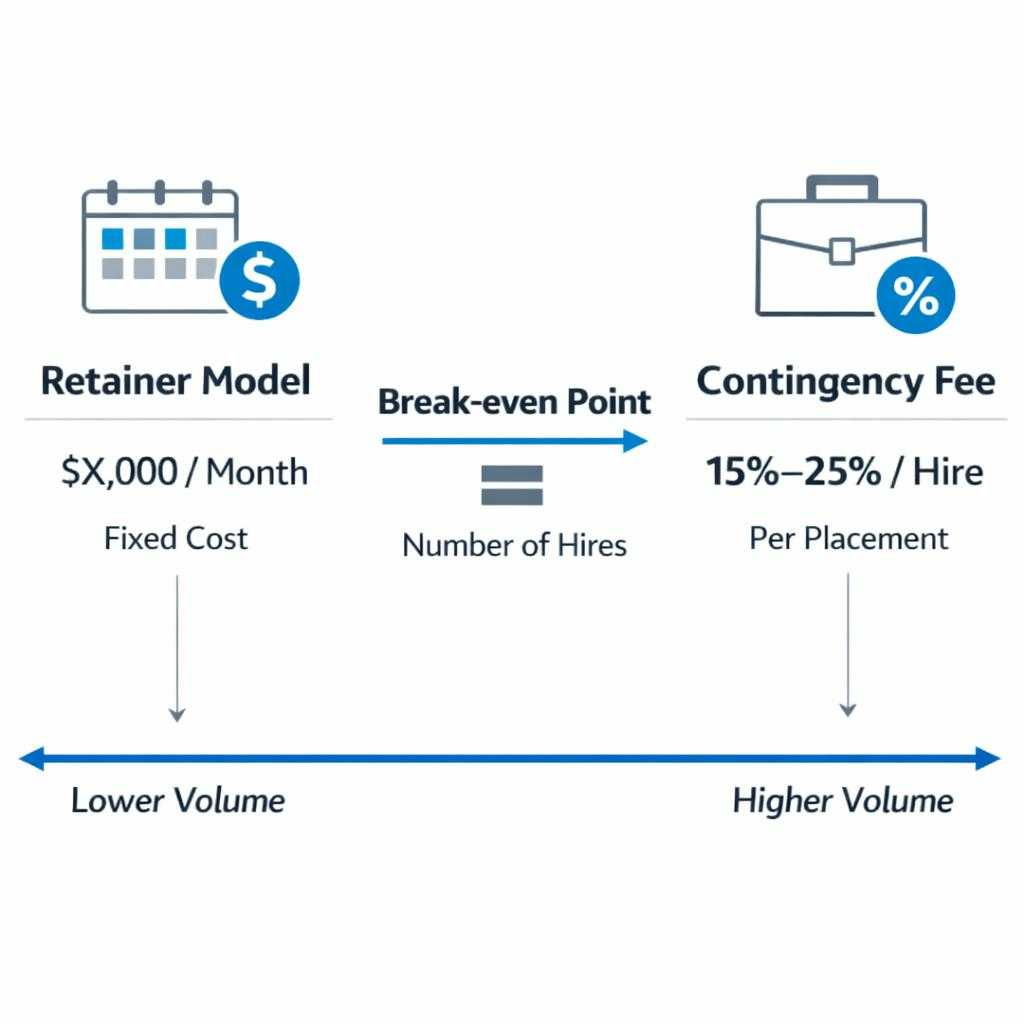
SHRM’s 2025 benchmark puts non-executive cost per hire at about $5,475, and contingency fees still commonly run 15% to 25% of first-year base salary. If you do not anchor the conversation in math, you will end up arguing about “expensive” with no baseline.
A fractional recruiting partner can pencil out or bleed budget, and terms often explain which one you’re buying. You’re buying weekly capacity, plus clear KPI numbers like reply rate, screens completed, and manager interviews booked. Choosing based on confidence on a call tends to buy optimism, not throughput.
Start with break-even math on recruiter retainer vs contingency. Contingency fees commonly land around 15% to 25% of first-year base salary, so a $90k hire can cost $13.5k to $22.5k for one placement. Compare that to a retainer in the roughly $5k to $20k per month band and ask: how many hires per year make the retainer the cheaper model, and what capacity are you actually purchasing (for instance, 10 hours per week is often framed in the $3k to $5k per month range)? Also sanity-check against internal cost: SHRM’s 2025 non-executive benchmark pegs cost per hire at about $5,475 before you count your team’s time.
Then test the constraints around minimum term, off-ramp, and current active load. In an MSP hiring two service techs and a dispatcher, a “6-month minimum” with no weekly reporting and no exit clause often means you’ll finance their learning curve. A real engagement spells out hours, concurrent searches, response-time expectations, and what happens if the funnel stalls for two weeks.
For MSPs, the fastest way to avoid noisy inbound is a repeatable outbound motion built around the exact service roles you hire most often. Read more in our article: Msp Recruiting
After You Pick: Run a 2-Week Proof
You don’t need months to learn whether a fractional recruiting partner is real. In the first two weeks, you’re watching for one thing. Can they produce signal on service tech, dispatcher, or estimator roles without you doing the recruiter’s job? If they can’t turn a messy intake into a usable scorecard and a live funnel quickly, the rest of the engagement turns into polite waiting.
By the end of week one, ask to see the artifacts. You need a finalized scorecard, a calibrated intake summary (what great looks like, what’s a deal-breaker), and the exact sourcing plan they’re running. For instance, if you’re hiring an MSP service coordinator, you should see outreach messaging, target titles, and a list build approach, not “we’ll post it and see.”
By the end of week two, you should see funnel evidence in the KPIs that matter. Outreach volume, reply rate, screens completed, and an emerging candidate-to-interview ratio should all be visible. If they can’t show weekly numbers and learning loops (what changed based on feedback), treat that as your off-ramp moment, not a delay.
FAQ
How Long Should I Take to Evaluate a Fractional Recruiter?
If you already have a clear role, scorecard, and comp band, you can evaluate 2–4 providers in a week using two short calls each. Don’t confuse a long sales cycle with due diligence; you’re trying to verify method, artifacts, and operating rhythm, not fall in love with a pitch.
Should I Evaluate More Than One Provider?
Yes, but cap it at 2–4 or you’ll create more coordination work than the recruiter is supposed to remove. Two is usually enough to surface real differences in methodology and sourcing engine, and four is the max before you start rewarding polish instead of proof.
What’s a Red Flag in a Fractional-Recruiter Sales Call?
They can’t name a methodology, won’t share funnel ratios or weekly reporting, or lean on “we have a database” as the sourcing plan. Another red flag is evasion on who does the day-to-day work and how many active searches they’re carrying right now, because bandwidth is the hidden variable in fractional engagements.
Related reading: Fractional Recruiting Cost in 2026 · Fractional Recruiting vs Contingency · Fractional Recruiting vs RPO
If you want to run these 7 questions against Discovered specifically, schedule a 30-minute call. We’ll answer them on the spot and give you the comparison sheet to use against the other providers on your shortlist.