
Fractional recruiting gives you a sourcing engine that keeps running between hires. Scheduling and reference-check coordination come off your plate. The result is fewer weeks lost to stalled feedback and cold starts. In this guide, you’ll see what industry benchmarks say, where time really goes in a typical hire, and how fractional compares to contingency recruiting. If you’re evaluating a fractional recruiting partner, this will help you set realistic expectations for your next 1 to 3 hires and decide whether fractional is the right lever to pull now.
What The Benchmarks Really Say
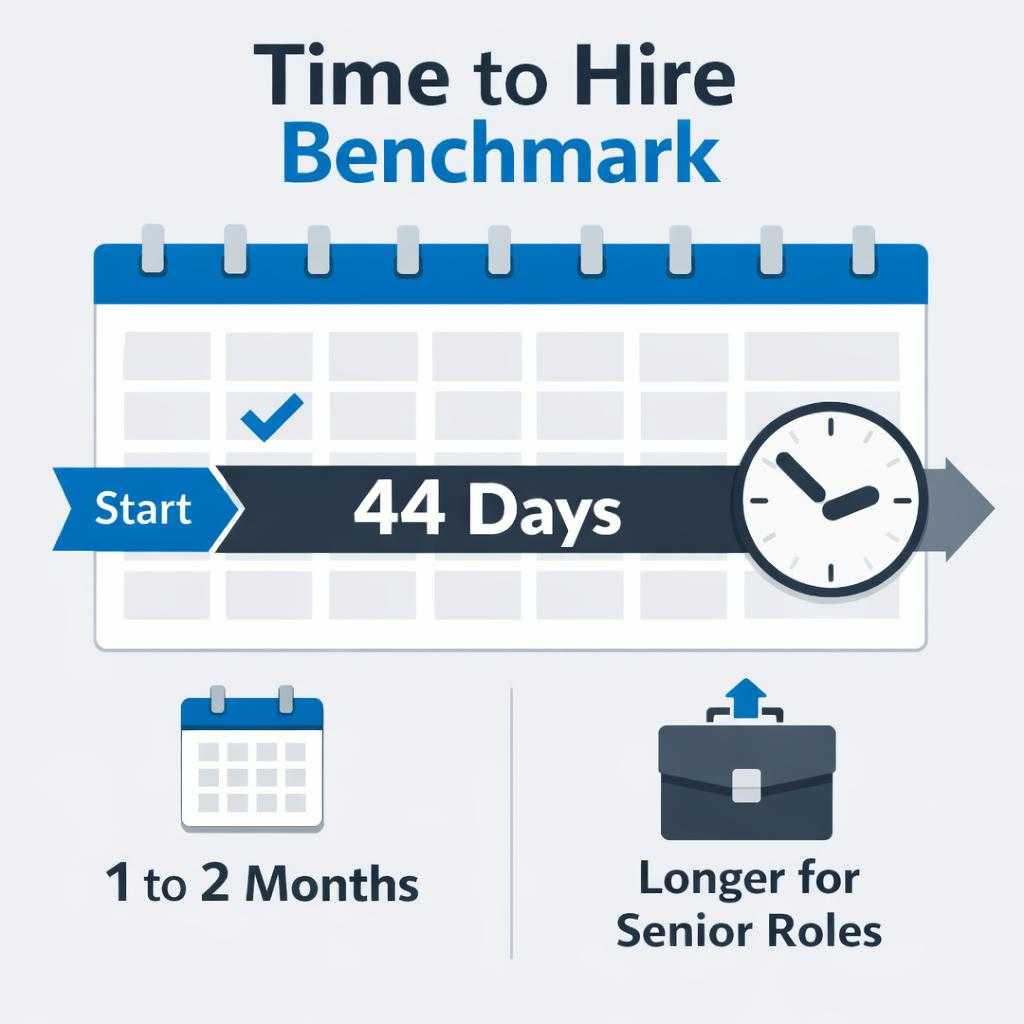
SHRM’s 2025 benchmark puts the median time-to-fill at about a month and a half, with executive roles dropping from 60 to 45 days year-over-year. If your plan assumes a clean 2-week sprint, you’re setting yourself up to misread normal variance as recruiter failure.
That median is a useful reality check when a role is still open at day 60. In plain terms, “a month to two months” is normal for many jobs, and specialized or senior roles often run longer.
What will mislead you is trusting any benchmark as a promise. Averages and medians don’t capture how fast you can get interview blocks on the calendar or how quickly you’ll give feedback. Planning around a single headline number means planning for the wrong thing.
If you’re hiring inside an MSP, the “time-to-fill” number becomes far more predictable when you have repeatable intake, outreach, and interview-blocking habits. Read more in our article: Msp Recruiting
Where Time Goes
Lack of applicants is rarely the reason a hire drags. The real problem is that the process can’t absorb candidates at the speed you’re generating them. For example, you might get five decent resumes in week two, then lose two candidates while you wait a week for a hiring manager to review, another week to find a panel slot, and three more days to collect feedback.
Break the cycle into stages: intake, screens, interviews, and the decisions that follow. You can push harder on the top of the funnel and still not reduce time-to-fill if your interview calendar is the bottleneck. In an MSP, escalations can keep pushing “we’ll interview Friday” to next week, and candidates accept elsewhere before you reach a technical round.
After reading this, you should stop asking “How fast can a recruiter find people?” and start measuring where you lose days: time from first shortlist to first interview booked and days between final interview and offer decision. That’s the timeline a fractional recruiter can stabilize only if you’re willing to run hiring like an operating rhythm, not an ad hoc task.
The teams that stabilize time-to-fill fastest usually track a small set of stage-based KPIs (like days-to-first-interview and feedback turnaround) and enforce them like operating SLAs. Read more in our article: 9 Essential Metrics To Track Hiring Success Retention
Time to Hire Fractional Recruiting: The Predictability Lever
Roles stop turning into emergencies the moment they open. When the pipeline is already warm, week 1 starts from a known position.
Fractional recruiting changes things dramatically in the first week. You’re buying continuity from someone who’s already mapped target companies and kept light contact with maybes before the requisition turns urgent. That steadiness can show up even when the applicant market stays flat.
The second lever is interview scheduling support and candidate follow-up ownership. In operator-led shops, delays come from jobsite fires and P1 escalations. You’re on job sites or handling escalations, and interviews slide. A fractional recruiter can run the weekly intake, interview-block, and debrief cadence like an ops process: pre-book interview blocks, chase scorecards the same day, and keep candidates warm with specific next steps. If you think “we just need more applicants,” you’ll keep adding top-of-funnel noise while the calendar remains the constraint.
To make the hiring timeline more predictable, ask for (and hold yourself to) a few time-based commitments:
-
Time from kickoff to first qualified shortlist
-
Time from shortlist to first interview actually booked
-
Feedback turnaround time after each round
Timing Tradeoffs by Hiring Model
The choice between fractional and other hiring methods comes down to how often your hiring process has to restart from zero, and how much coordination work you personally keep. A contingency recruiter can be excellent and still deliver volatile timelines because the model rewards urgency on open reqs, not maintaining a warm bench for the next role. By contrast, fractional tends to feel quicker on hire #2 and #3 because the sourcing engine doesn’t shut off, so week 1 of a new opening often looks like week 8 of relationship-building.
If you want fewer 90-day surprises, choose the method that fits your jobsite schedule or on-call escalation load, including how quickly you can review shortlists and protect interview blocks. If the story is “we just need more resumes,” you’ll keep feeding the funnel while delays keep living in your calendar and feedback loop.
In MSPs specifically, fractional recruiting works best when it’s treated as an always-on pipeline function rather than a one-off req-by-req reset. Read more in our article: Fractional Recruiting Msps
| Hiring Model | What Usually Sets The Pace | Where It Typically Slows Down | What You Can Control To Stabilize Timeline |
|---|---|---|---|
| Fractional Recruiting | Continuous pipeline plus active coordination through your stages | Your availability for interviews, slow feedback, offer delays, counteroffers | Pre-book interview blocks weekly, commit to 24 to 48-hour feedback, lock comp band and must-haves before kickoff |
| Contingency Agency | How quickly the agency can produce viable candidates for this specific req | Cold start on each role, misalignment on spec, you get buried in mixed-quality profiles | Tight intake, fast “yes/no” on submitted profiles, same-day declines with reasons to prevent repeat mismatches |
| Retained Search | Depth of market mapping and outreach for senior or specialized roles | Longer calibration cycles, stakeholder alignment, extended closing process | Reduce Finance, HR, and the hiring manager, define decision rules early, schedule finalist debrief before finalists start interviewing |
| Internal Recruiting (In-House) | Your team’s capacity and process maturity across multiple priorities | Backlog of roles, recruiter ramp time, inconsistent hiring manager responsiveness | Standardize scorecards, enforce SLAs for hiring managers, limit concurrent open roles per recruiter |
What Slows Fractional Down Too
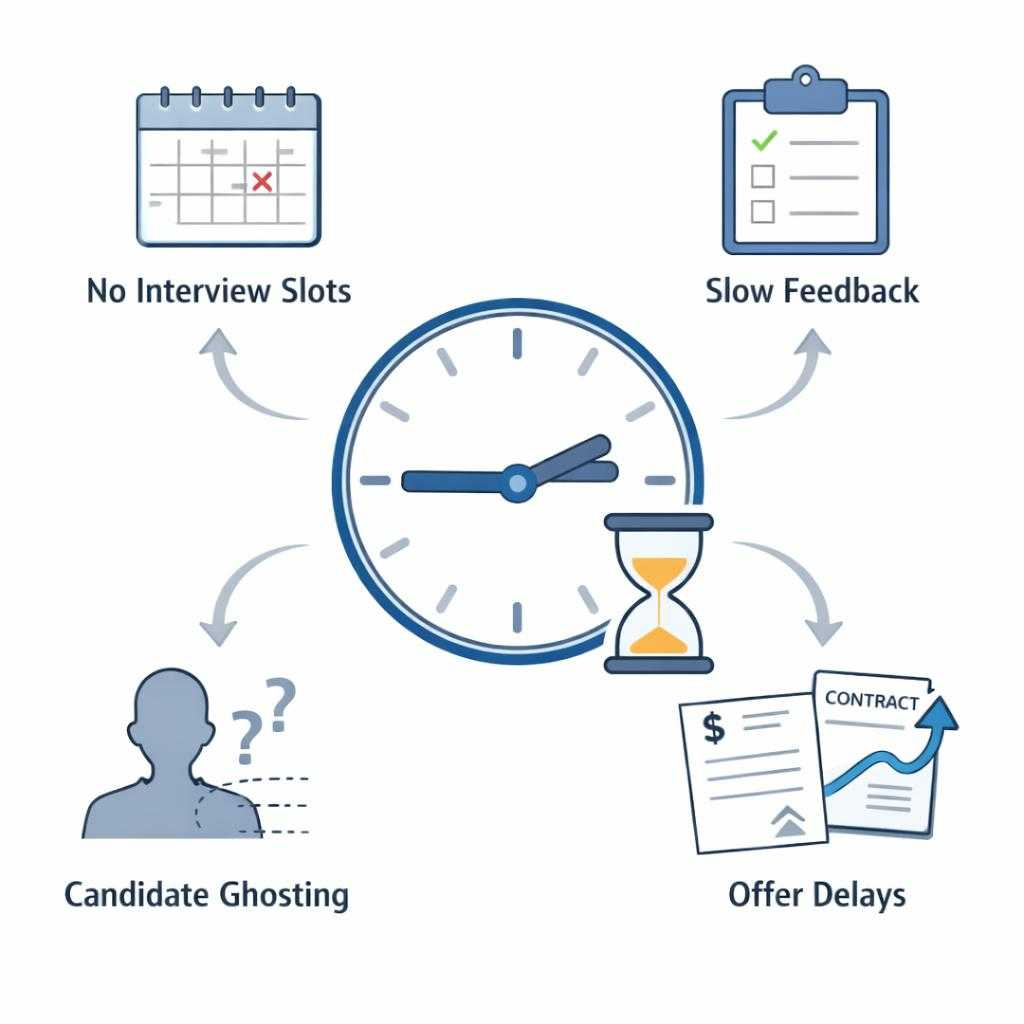
You can have a strong shortlist and still be in the same spot two weeks later if interviews keep slipping. When feedback drags and approvals stall, candidates do what candidates do and move on.
Fractional recruiting doesn’t change the basics of hiring. Your timeline still stretches when you can’t hold interview blocks, when the service manager or the owner goes dark for a week, or when the comp band and must-haves keep changing midstream. Candidate behavior matters too: counteroffers, slower notice periods, and the occasional ghosting can add days even with strong process.
To illustrate this, if you’re a construction firm and the PM you need is also the one covering a jobsite fire, interviews slide, scorecards don’t get submitted, and a ready-to-go finalist takes another offer. If you want a faster outcome, stop blaming sourcing when the real limiter is your calendar and your 24 to 48-hour yes or no speed.
Your Next 30 Days: A No-Regrets Speed Test
A COO agrees to “try fractional” after a painful 70-day search, but the first week looks identical to the last one: no interview blocks, no scorecards, no decisions. The fastest fix is turning hiring into a weekly rhythm you can actually keep.
If you’re debating whether it’s time to hire fractional recruiting, don’t approach it like a months-long bet. Treat the first 30 days as a 30-day pilot of process predictability: can someone run intake, keep candidates warm, and keep your offer-approval loop from turning into a two-week stall.
A 30-day pilot isn’t a resume-count contest. It measures whether your scorecards, interview blocks, and debriefs actually moves. For instance, you can pre-book two interview blocks per week and commit to 24 to 48-hour feedback before sourcing starts. Then you watch whether the pipeline advances on schedule. If your timeline still slips, you’ll know the constraint lives in your calendar and decision-making, not in a recruiter’s effort.
FAQ
How Fast Can Fractional Recruiting Fill A Role?
Fractional recruiting can land in the same general 30 to 60-day window you see in industry benchmarks, but the bigger win is that your next hire becomes more predictable because the pipeline doesn’t restart from zero. You should judge “fast” by whether you get a qualified shortlist quickly and whether interviews actually get booked on time.
Why Is Time-To-Fill So Variable In Fractional?
It swings based on role difficulty and market fit, but also on your internal tempo: how quickly you approve the spec and make decisions. Moving comp bands or shifting must-haves creates rework that no recruiting model can paper over.
Is Fractional Faster Than Contingency?
It can be, especially on hire #2 and #3, because fractional keeps a continuous sourcing engine running instead of going cold between your next PM, service manager, or dispatcher hire. If you want a clean comparison, track one thing: days from kickoff to first interview booked, not “how many resumes showed up.”
What’s The Slowest Part Of The Fractional Hiring Process?
Most delays come after you have candidates: scheduling and decision-making. If you can’t protect interview blocks and return scorecards within 24 to 48 hours, you’ll feel “slow hiring” even with a strong recruiter driving the front end.
Related reading: Signs You’ve Outgrown Contingency Recruiting · How to Choose a Fractional Recruiting Partner · Fractional Recruiting Cost in 2026
If you’ve been waiting 60+ days on a role and the contingency recruiter just said “we’re still looking,” schedule a 30-minute call with Discovered. We’ll show you what week 1 of a fractional engagement looks like and whether we can plausibly beat your current timeline.