
Tech recruitment firms fall into four models, and the model predicts behavior. The fee structure tells you more about how a firm will work your search than anything on its website.
An MSP owner without an internal recruiter has little use for another top-ten list. What helps is a fast way to shortlist two or three firms and see which one can recruit your roles and return your calls. Most arrangements let you run that test at no cost until a hire closes, and the first month of a flat monthly model tells you the same thing. The two-week test and the scorecard for it are below.
The Four Tech Recruitment Firms You’ll Meet
Most tech recruitment firms look identical on paper. They separate in week two. Four kinds exist, and most managed service providers (MSPs) meet them in this order.
A generalist contingency firm recruits across every industry and gets paid on the close. Expect speed first and role nuance later. A specialist tech contingency firm runs on the same fee with a narrower bench. It should already know the difference between an L2 help desk tech and a Tier 3 service tech without you translating.
A retained search firm collects a retainer against one senior seat. That’s the right tool for a vCIO or an ops leader and the wrong one for your next help desk opening. A fractional recruiting firm charges one flat monthly fee and works as your recruiting department across every open role. Discovered Search is one example of that fourth model.
The reason you’re shopping at all is usually that recruiting has been a side duty. As Fletcher Wimbush puts it, “HR people are not recruiters. Making a compliance admin focused HR person do recruiting is like making an accountant do sales.” The first two things to slip when hiring is a side duty are speed and candidate follow-up, so judge a firm on exactly those.
| Firm Type | How It’s Paid | What It’s Paid For | Best Fit for an MSP |
|---|---|---|---|
| Generalist contingency | 20 to 30 percent of first-year salary | The placement closing | One direct hire when speed matters most |
| Specialist tech contingency | 20 to 30 percent of first-year salary | The placement closing | One technical hire where role fluency matters |
| Retained search | A retainer against one role | A dedicated search on that seat | An executive or hard-to-source senior hire |
| Fractional (flat monthly fee) | $1,500 a month on a six-month commitment, or $2,500 month to month | Recruiting coverage across every open role | Two to five hires a year with no internal recruiter |
How the Fee Predicts the Firm’s Behavior
On Monday, two firms agree they can find your network engineer. By Friday, one is pushing whoever will say yes and the other is still asking about your environment. They’re paid for different outcomes, and that’s the whole difference.
A paid-on-close shop has to optimize for the start date. That isn’t a moral judgment. Expect speed and volume before you see careful matching.
Under contingency you’ll usually pay 20 to 30 percent of first-year salary. On a $120,000 network engineer, that’s $24,000 at 20 percent and $36,000 at 30 percent. The payoff arrives at acceptance, so you’ll see quick submittals and a push to move fast. Notice the percentage too. It rises when you agree to pay the candidate more, so the firm earns more when you spend more.
Retained search pays the firm to run a dedicated search on one seat. That usually means a slower intake and a tighter slate, because the firm isn’t trying to win by being first in your inbox.
A flat monthly fee reverses the incentive. At $1,500 a month on a six-month commitment, or $2,500 month to month, the firm gets no bonus for a higher salary or a rushed acceptance. It keeps the engagement by filling seats well and keeping candidates warm, which is where side-duty hiring usually stalls. The full comparison of fractional and contingency recruiting covers the model argument in depth. The short version is to price both against the same role and salary band before you sign anything.
Run the Two-Week Test
Judge tech recruitment firms by their logos or by how fast the resumes arrive and you’ll choose the one that’s best at marketing to you. Run the same two-week test with two or three firms instead, and watch what they do before you’re invested in any candidate.
- Send the same one-page role brief to two or three firms on the same day. Keep it short and real. Name your ticketing stack, your client mix, the on-call rotation, and what the first 90 days should produce.
- Track what happens before the first submittal. A firm that can recruit MSP roles asks about escalation paths and after-hours coverage before it sends anyone. A firm that submits within hours skipped that step and forwarded whoever looked close.
- Read the first three submittals from each firm the way you’d read a ticket. You asked for an L2 help desk tech who can handle escalations. Did the recruiter write a note on what this person does with a hard ticket, or did a resume arrive with no explanation?
- Interview one candidate from each firm and open with one question. “What did the recruiter tell you about our company and this role?” You’ll learn in a minute how much the recruiter told the candidate about on-call and expectations, or that they told them nothing.
- Keep two counts running for 14 days. Days from brief to first qualified candidate, and how many messages it took to get an answer. The firm that makes you chase updates in week one will make you chase them in week eight, when your service desk is short a person.
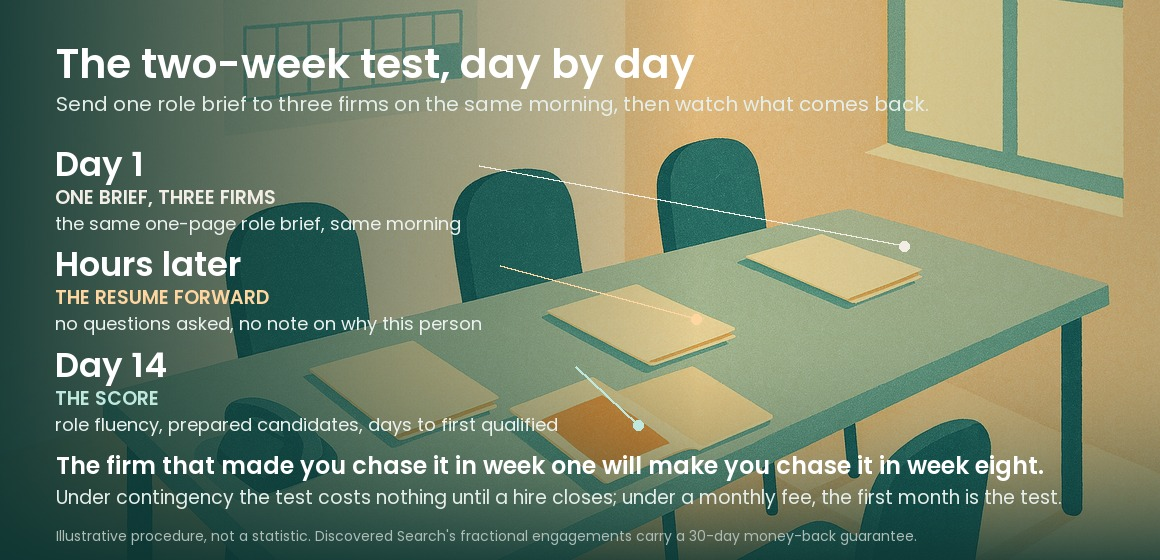
The test is cheap by design. Under contingency it costs nothing until a hire closes. Under a monthly fee the first month is the test, and Discovered’s fractional recruiting carries a 30-day money-back guarantee.
Score the First Two Weeks
Reward the fastest inbox and you’ll end up doing the screening yourself. Scoring what happened, rather than what was promised, catches that before you’re paying for it.
Give each firm a 1 to 5 on seven things.
- Role fluency: Could they describe the difference between the seats you hire for without the job description?
- Questions before submitting: Did they ask about the environment, the client mix and on-call before the first resume?
- The first three submittals: Did each one come with a reason for this person, or only a resume?
- Candidate preparation: Did the candidate know your company and the role before the interview?
- Responsiveness: Days to the first qualified candidate, and messages sent per answer received.
- The month-two question: What happens to the fee if the hire leaves in month two?
- The second role: Is your next opening covered, or quoted as a new engagement?
Expect a typical fill of 4 to 12 weeks for a quality hire. A firm that promises a much shorter window on a senior seat is selling speed over fit. The questions to ask an IT staffing agency before you sign are a separate list, worth running alongside this one. That piece also prices the three staffing arrangements.
Which Kind of Firm Fits Your MSP
Be fair to the agencies. One senior or hard-to-source seat, an executive role, or a market where you have no network, and a contingency or retained search firm earns its fee. You pay once and you’re done.
Two to five technical hires a year with nobody inside recruiting full time is a different purchase. You’re buying the same service over and over at per-hire prices, and paying the most for the hire that was hardest to find. Those per-hire prices point at a monthly fee. Check it against your own hiring plan for the next twelve months rather than taking our word for it. Then read what an IT recruiter does before you decide if you need one at all.
Frequently asked questions
Can You Test Several Tech Recruitment Firms at Once?
Yes. Send the same one-page brief to two or three firms on the same day and score the next 14 days. A firm that can’t stay responsive while it’s trying to win your business won’t improve once you’re mid-search.
What Does It Mean When a Firm Submits Candidates Within Hours?
Usually that the recruiter skipped learning your environment, so you’ll do the screening. Ask what questions they asked before submitting and what they told the candidate about your company. The answers tell you which one you got, recruiting or a resume forward.
How Long Should It Take to Fill an MSP Technical Role?
A typical quality fill runs 4 to 12 weeks, depending on seniority and how tight your requirements are. Anyone promising much less on a senior seat is trading fit for speed.
Should You Use a Retained Search Firm for Help Desk or Tier 3 Roles?
Usually no. Retained search makes sense for an executive or an unusually hard senior hire, because you’re paying for dedicated focus on one seat. Day-to-day MSP roles get better economics from a model built for ongoing hiring.
Is a Flat Monthly Fee Overkill When You Only Make a Few Hires a Year?
Count the hires. One month of fractional at $1,500 costs less than one contingency fee, so the models separate at hire number two. Recruiting as a side duty fails first on speed and candidate follow-up, and a monthly fee covers exactly those two.
If fractional looks right on paper and you want to test it against your own hiring plan, schedule a 30-minute call with Discovered and we’ll run the numbers with you.