Use one IT recruiting agency per open role. Three on the same seat almost never pays.
If you run an MSP with no dedicated recruiter, adding agencies feels like adding capacity. Agencies add speed of first submittal and not much else. What follows is duplicate candidates, arguments over who owns them, and interview blocks your service manager can’t get back.
What Happens When Three Agencies Share One Role
Send one role to three agencies and you’ve started a race. Each firm earns a fee only if it closes the hire. So the rational first move is to send whoever is already in the database, before a rival does.
Resumes arrive inside 48 hours. Plenty of them are near misses, NOC techs and desktop support candidates put forward against a Tier 3 opening.
Real headhunting stops under those conditions. Persuading a working senior sysadmin to take your call takes three weeks, and a competitor can win the role in three days with a decent active job seeker. You didn’t buy three search partners. You started a timing contest. That’s worth knowing before you compare firms on responsiveness, which is the trap in how most MSPs test a recruitment firm.
A shared role also tells the agency something about its own odds. Every recruiter keeps a mental queue, and a search they’re likely to win outranks a four-way race they probably lose. Your role doesn’t get the recruiter’s Tuesday morning. It gets whatever’s left after the exclusive ones.
Speed of first submittal is a different thing from time to fill. Ten resumes on Friday still leave you doing the triage and the technical screens. A quality technical hire typically takes 4 to 12 weeks whoever runs the search. Owners tell us they review 1,000 or more applications and run 20 or more interviews per hire. Three agencies don’t reduce either number.
What Duplicate Submittals Cost You
One candidate arriving twice moves you from running the search to refereeing it. Two firms claim the same person, and a fee is in dispute before anyone has interviewed.
Sorting that out means reconstructing who spoke to the candidate first, and if the candidate ever agreed to the submittal. Nobody at a 12-person MSP has hours for that. Not having those hours is why you called an agency.
Your service manager books a Tuesday interview. A second recruiter calls Wednesday claiming ownership. The interview slips, your team hesitates, and the candidate can hear that they’ve landed in an argument about money.
You never see that cost on an invoice. You pay it in calendar time. Dedupe, referee, repeat.
What Candidates See in a Small Market
MSP hiring markets are small and local. The sysadmins inside a reasonable commute of your office are a list you could nearly write out by hand.
A good candidate who hears from three recruiters doesn’t experience broader coverage. They get three calls and two LinkedIn messages about one job, with pay ranges that don’t match and details that conflict.
That reads as disorganization. A senior help desk lead hearing one role pitched three different ways assumes the company runs its client work the same way. The strongest passive candidate on your list stops replying, and never tells you why.
One clean outreach lane protects the asset you can’t buy back, which is your name in a market of a few dozen techs.
One Owner for Every Open Seat
Adding firms multiplies the threads you manage. It rarely multiplies the hours anyone spends on your role. Most agencies are small, so three engagements can mean three part-time recruiters with other searches ahead of yours.
What changes an outcome is one owner running your whole hiring plan instead of one requisition. Your service manager owns escalations alone for the same reason. Three techs working a ticket in parallel is how it ages.
That owner can be an internal hiring manager with real hours blocked off, or one fractional recruiter working inside your plan. With fractional recruiting you rent that ownership by the month rather than paying per placement. Sourcing, screening, structured assessment, interview coordination and reference checks are all inside the fee, across every seat you have open. It’s a narrower job than what an IT recruiter does under a contingency arrangement, and a wider one.
An owner also carries the parts no agency touches. Scheduling around a service manager who’s on a client site. Chasing interview feedback before a candidate goes cold. Staying in touch between the offer and the start date, because a counteroffer arrives in that gap more often than owners expect.
What Three Hires Cost Each Way
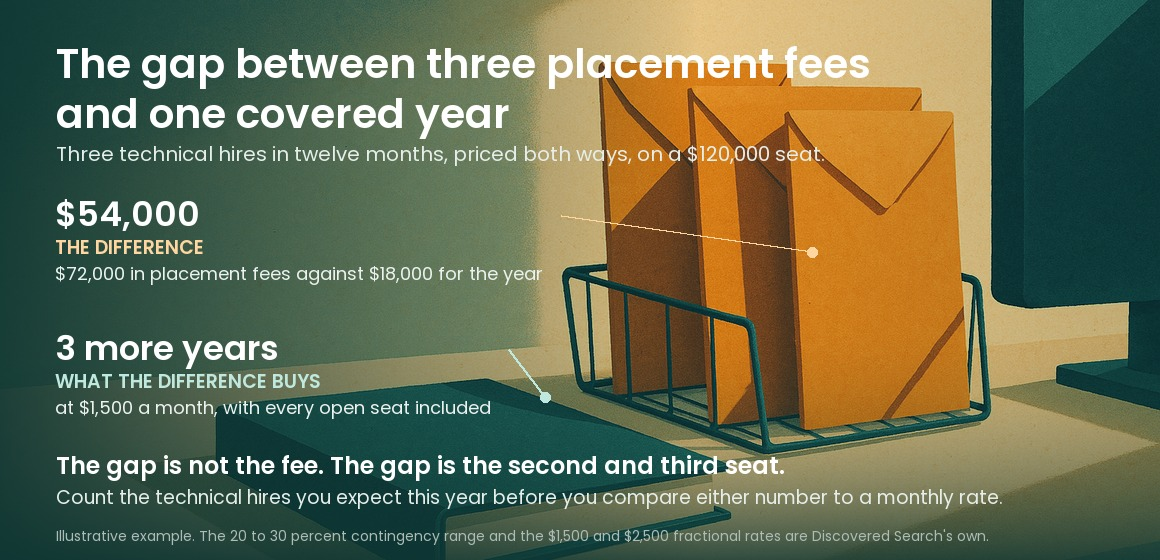
A contingency fee runs 20 to 30 percent of first-year salary. Take a $120,000 seat as the illustration. Twenty percent of it is $24,000 for one hire.
| Row | Three Agencies on Contingency | One Flat Monthly Fee |
|---|---|---|
| Who sources | three databases racing | one recruiter, your whole plan |
| Cost of three hires | $24,000 each, $72,000 | $1,500 a month, $18,000 for the year |
| Roles covered | the one role each was sent | every open seat in the engagement |
| Your admin load | dedupe, referee, four sets of calls | one point of contact |
| If a hire does not happen | no fee, and no progress either | 30-day money-back guarantee |
Three hires in a year at that rate is $72,000, owed one seat at a time. Fractional runs $1,500 a month on a six-month commitment, or $2,500 month to month, and it covers every role you have open. Twelve months at the committed rate is $18,000, with a 30-day money-back guarantee at the front of it.
Both figures are real money. Only one of them is predictable in January, and only one of them covers the second seat you open in March. If the model interests you, here’s how a fractional recruiting engagement runs.
When More than One Agency Makes Sense
Two situations make a second firm the right call, and pretending otherwise would be a sales pitch.
The first is a one-off senior seat where the networks differ. A service leader or vCIO search can reach into two separate worlds, one of them compliance-minded and one of them MSP leadership. Two retained-style firms with different candidate pools will calibrate title and pay faster than one firm will.
The second is contract coverage. If a project slips without another body next week, you’re buying something other than a permanent hire, and a multi-vendor bench handles it fine. Our piece on when tech staffing agencies fit an MSP seat covers that call, and the fee models behind it are there too.
If you do run two firms, cap the duplicate risk:
- Hold it at two, and give each one lane, by geography, skill band or seniority.
- Require written candidate consent before any submittal, so one person can’t end up with two owners.
- Run one intake document and one weekly check-in covering both firms.
Frequently Asked Questions
How Many IT Recruiting Agencies Should Work One Role?
One, in almost every case. Two can work if you split the lanes on paper and you have the hours to manage both. Three on one seat turns into a resume race and duplicate submittals nearly every time.
Can You Split One Role Between Two Agencies by Candidate Source?
Yes, if the split is operational rather than verbal. Define the lanes by geography, skill band or seniority, require candidate consent before submittal, and keep one intake document. Avoid the real failure here, which is two versions of one role loose in the same market.
What Happens When Two Agencies Submit the Same Candidate?
You stop hiring and start arbitrating. Reconstructing first contact and consent takes days, and good candidates cool off or withdraw while you do it. If neither firm can prove who got there first, you’ve bought a delay nobody needed.
Does Using One Agency Mean Fewer Candidates?
Fewer resumes, usually. Better interviews, usually, provided that one owner sources rather than recycling a database. Ask how many names on the first shortlist someone approached for this role specifically, and how many came out of a file.
Is Exclusivity Worth Asking For?
It’s worth asking when you hand one owner the whole search and you want clean accountability. It buys you nothing if your side can’t give feedback inside 48 hours and schedule interviews quickly. Exclusivity won’t fix internal delay.
If fractional looks right on paper and you want to test it against your own hiring plan, schedule a 30-minute call with Discovered and we’ll run the numbers with you.