You hire an engineering recruitment agency to call the engineers who never apply.
Agencies source, screen and coordinate interviews for the network, cloud and security seats your job posts don’t fill. Typical fill is 4 to 12 weeks. You’ll pay by contingency, by retainer, or by a flat monthly fee, and that choice decides more than the size of the invoice.
If you run a managed service provider (MSP), the pattern is familiar. You post the role, a few applicants arrive, and the engineer who could own client migrations stays busy at another shop. The question that matters is who makes the calls when the first answer is no.
The Engineer You Want Isn’t Applying
A job ad finds the small group of engineers who want out this month. Your next senior engineer is mid-migration, carrying an on-call rotation, three weeks out from a cutover. Nobody in that position browses job boards on a Tuesday afternoon.
So you go find the rest. Write a message that earns a reply, then follow it with a second and a third contact weeks apart, without turning into spam. Somebody has to own that thread for as long as the seat stays open, and own it for four or five candidates at once. Most internal attempts stall right there, and not because the person doing it lacks the skill. As Fletcher Wimbush puts it, “HR people are not recruiters. Making a compliance admin focused HR person do recruiting is like making an accountant do sales.”
What an agency sells, stripped of the pitch, is that sustained attention. Sourcing a name is the easy half. The hard half is the fourth follow-up with someone whose change window moved again, in a week when you’re deep in escalations and quarterly reviews.
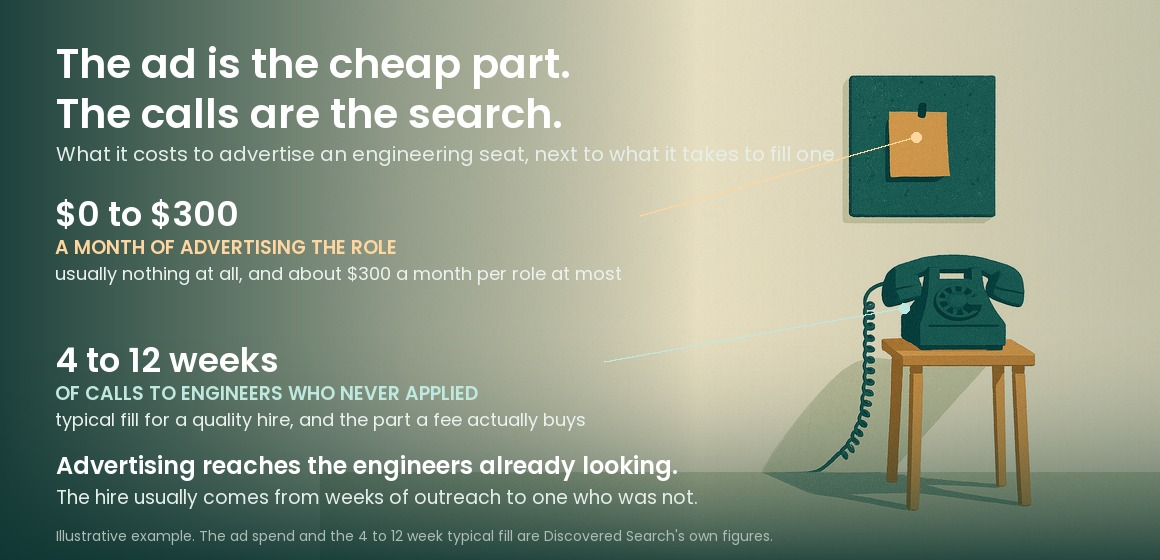
Advertising isn’t where the money goes either. Ad spend on a Discovered search is typically $0, and about $300 a month per role when a campaign helps. Paid reach puts you in front of the same small group already scanning job boards, and every other firm in your market advertises to them too. The expensive input is weeks of somebody’s time, and that’s what a fee buys.
Why the Fee Model Decides Who Gets Called
Under contingency, the agency earns nothing until someone signs, and then takes 20 to 30 percent of first-year salary. On a $120,000 engineer at 20 percent, that’s a $24,000 fee. Until the close, it’s $0. So the rational move is to spend the week on candidates who already interview elsewhere, answer the phone, and want to move. Those three things make a signature likely inside the month. Six weeks of patient follow-up with an engineer who then stays put pays nothing.
None of that is a character flaw in recruiters. The model pays for closes, so closes get the hours, and that’s how a growing MSP finds it has outgrown contingency recruiting without anything going visibly wrong.
Retained search funds the work up front, so a pursuit can survive a month with no yes in it. A flat monthly fee does the same thing on a number you can forecast. Ours is $1,500 a month on a six-month commitment, or $2,500 month to month, with unlimited sourcing and screening across every open role and a 30-day money-back guarantee. A two-month pursuit costs the same as a two-week one, so nobody has a reason to abandon the slow candidate.
The models laid out side by side, with the break-even math, are on our engineering recruiter page. Settle one question before you compare them. Do you need engineers who answer an ad this week, or sustained pursuit of one who moves only when the timing and the scope line up?
What You Hear When a Good Engineer Hesitates
Reach an employed engineer and you rarely get a clean no. You get a delay, a qualifier, or a question about specifics. Read that as rejection and you’ll work through your whole list in a month, then conclude the market is empty.
Hesitations almost always trace back to the calendar or to scope, whether the seat is a network engineer at an MSP or a project engineer who signs drawings. The engineer is inside a change window. They’re accountable to a client through a go-live. They won’t risk an on-call expectation nobody has described in plain terms. The next move is a specific follow-up date, plus one detail that lowers the risk for them.
| What You Hear | What It Usually Means | What Has to Happen Next |
|---|---|---|
| I’m in the middle of a project | Timing is real. They can’t disrupt delivery or burn social capital mid-sprint. | Agree on a date and a time to reconnect, and send a two-sentence role snapshot they can read between meetings. |
| I’d need to know who stamps the drawings | They’re protecting their license and their chain of responsibility. | Clarify who owns sign-off, and put the reporting line in writing before any formal interview. |
| I can’t do five days on site | A logistics and family constraint, which no raise fixes. | Confirm the true on-site requirement and what remote means week to week. |
| Ask me again after bonuses | They won’t move inside a known financial milestone. | Set the follow-up for the week after payouts, and keep them warm with one real update, not weekly pings. |
Every one of those rows needs an owner and a date attached to it, or the candidate ages out of the search without anyone noticing. That’s why each open name carries a dated next action in our weekly report.
What to Ask an Agency About Outreach
An owner signs an agreement, waits two weeks, and gets five resumes they already saw last year. The difference between real headhunting and inbox forwarding lives in details nobody volunteers on a sales call. Plenty of firms describe recycling an old database as headhunting, and the word costs them nothing.
Four questions get at it.
- Of last year’s placements, how many started as direct outreach rather than an application or a name already in the database?
- Who makes the calls day to day, and is that person in this meeting?
- When a candidate says call me in March, where does that lead go, and who owns the date?
- In week one, before any names arrive, what gets built and what goes out?
Answers that hold up sound specific and faintly boring. A real one names the person, the list, and the week. A weak one talks about reach and relationships. Ask for two examples of a candidate who said no the first time and signed later, including how long it took.
The vetting questions that go with those, the ones about disciplines and placements in your own specialty, are on our page about choosing an engineering recruitment company.
When You Don’t Need an Agency
Skip the agency if your own postings already bring in qualified engineers and you can move on them fast. Tightening the screen is a cheaper lever than buying more sourcing. Two or three solid referrals, plus open slots on your calendar this week, beat any outside fee.
You also don’t need one for a single hire every couple of years with a long window in front of it. Same answer if someone on your team will do real outreach for six to eight weeks and has the hours protected to do it. For that reader, a self-serve recruiting platform at about $1,400 a year is enough tooling.
An agency earns its fee in one situation. The calls have to happen every week, and nobody inside the building has the time to make them.
Frequently asked questions
Do Engineering Recruitment Agencies Mostly Work with Passive Engineers?
Most strong candidates still hold a job and a live project when the first contact lands. A good agency starts that conversation and keeps it alive for weeks, which is different work from forwarding the applicants who arrive on their own.
What’s a Typical Time to Fill with an Engineering Recruitment Agency?
Typical is 4 to 12 weeks for a quality hire. The swing is mostly on your side of the table. It depends on how fast your team schedules interviews, and how quickly a decision follows once a candidate says maybe.
How Does the Fee Model Change Cost Predictability?
Contingency stays unpredictable, because the fee is a percentage of a first-year salary you haven’t negotiated yet. A flat monthly fee is a fixed number for as long as the search runs, and it covers every open role rather than one seat.
What Should You Watch for to Avoid Paying for Inbound Only?
Ask what share of last year’s placements began as direct outreach, and who personally made those calls. If the person selling the service won’t own the follow-up calendar, you’re buying a resume-forwarding service at a headhunting price.
Where Can You See How Discovered Finds Candidates?
Our page on how we find candidates lists the channels we use and what each one is good for. Read it as a checklist for any agency you’re considering, including us.
If fractional looks right on paper and you want to test it against your own hiring plan, schedule a 30-minute call with Discovered and we’ll run the numbers with you.